How Each Technology Removes Moisture
All dryers accomplish the same goal — evaporating water from wet laundry — but the three main technologies go about it in fundamentally different ways. Understanding the mechanism behind each helps clarify why installation requirements, running costs, and performance characteristics diverge so sharply.
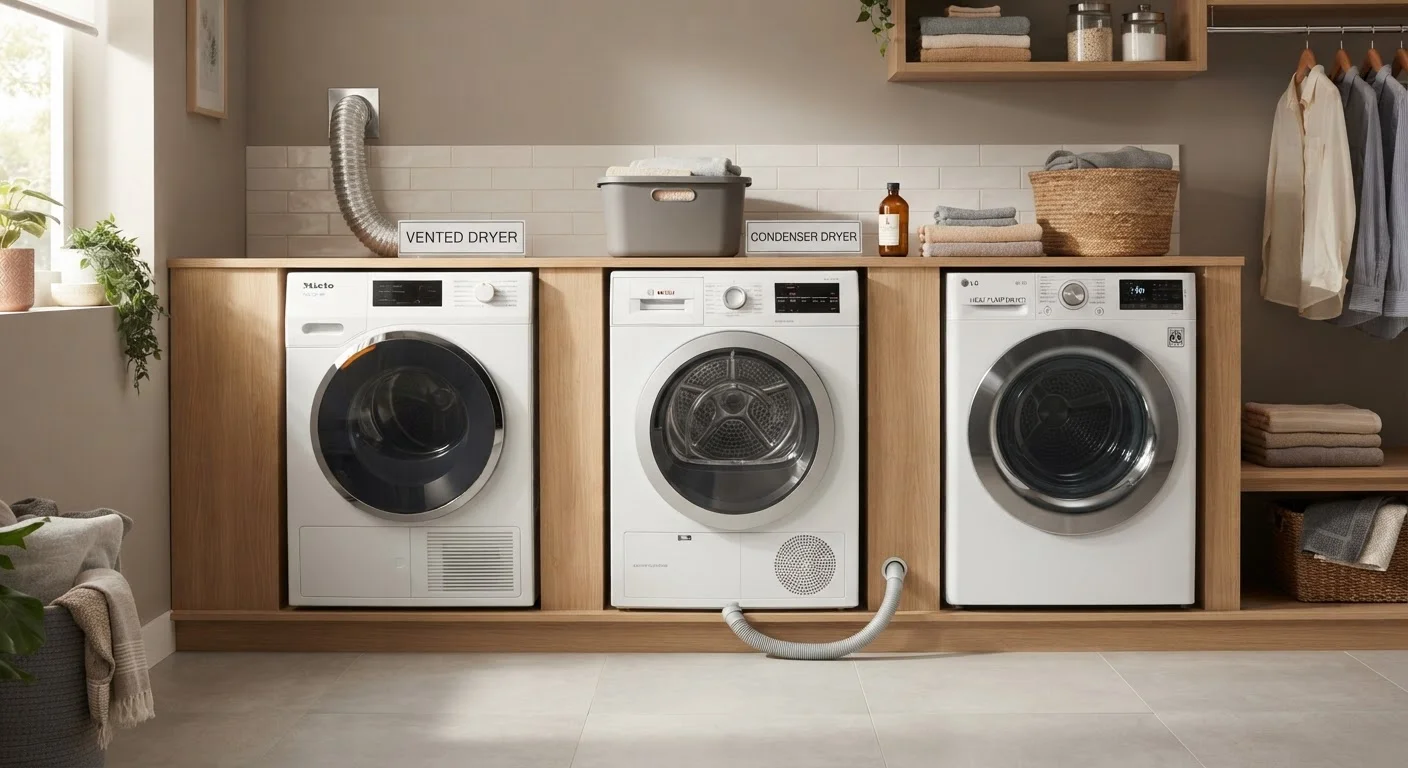
Vented dryers draw in ambient air, heat it using either a gas burner or an electric resistance element, pass it through the drum, and then expel the now-humid air directly outside through a rigid or flexible duct. The process is continuous and relatively simple, which is why vented dryers tend to be the fastest and least mechanically complex of the three types.
Condenser dryers take a different approach: instead of exhausting moist air externally, they cool it inside the appliance so that the water vapor condenses into liquid. That collected water either drains away through a hose or accumulates in a removable tank that must be emptied regularly. Because no external duct is needed, placement flexibility increases considerably.
Heat pump dryers extend the condenser concept by using a refrigerant-based heat exchanger — similar in principle to the system described in our look at refrigerator cooling systems. Rather than generating fresh heat for every cycle, the heat pump recaptures and recycles the warm air already in the drum, requiring far less electrical energy overall. The trade-off is a longer cycle time and a higher purchase price.
For a broader grounding in dryer terminology — including moisture sensor types and drum capacity ratings — see our laundry appliance specs glossary.
| Vented | Condenser | Heat Pump | |
|---|---|---|---|
| Moisture removal method | Exhausts humid air outside via duct | Condenses moisture into tank or drain | Recycles warm air via heat exchanger |
| External duct required | Yes | No | No |
| Typical cycle time | 45–60 minutes | 50–70 minutes | 60–90 minutes |
| Energy consumption | Higher (resistance heat) | Moderate (resistance heat) | Lower (heat recycling) |
| Drum temperature range | 135–175°F | 130–165°F | 120–140°F |
| Fabric gentleness | Lower | Moderate | Higher |
| Purchase cost range | Generally lower | Mid-range | Generally higher |
| Placement flexibility | Limited by duct access | High — interior rooms viable | High — interior rooms viable |
Installation Requirements and Space Considerations
Installation constraints often narrow the choice before performance specs even come into play. Vented dryers require an unobstructed duct path to an exterior wall — typically 4-inch rigid or semi-rigid metal ductwork. Duct length, bends, and termination style all affect airflow; a restricted vent is one of the more common reasons clothes remain damp after a cycle, as outlined in our guide on why clothes stay damp after drying.
Condenser and heat pump dryers require only a standard electrical outlet and, for tank-style condenser units, periodic manual draining. This makes them viable in apartments, closets, or interior utility spaces where running ductwork is impractical. Heat pump models with drain hose connections can be fully automatic, removing the tank-emptying task entirely.
Ductwork Length Affects Vented Dryer Performance
For vented dryers, the total effective duct length — accounting for bends and elbows — should generally not exceed the manufacturer's specified maximum, often around 25 feet for a straight run. Each 90-degree elbow typically reduces allowable duct length. Exceeding these limits restricts airflow, extending drying times and increasing lint buildup risk. Check your model's installation manual for the specific routing limits before purchasing.
Before any dryer is delivered, confirming utility hookups, room dimensions, and — for vented models specifically — duct routing is essential. Our pre-delivery checklist covers the key variables to verify in advance.
Energy Use, Cycle Times, and Fabric Considerations
Energy consumption differs substantially across the three types. Vented and standard condenser dryers rely on resistance heating elements that convert electricity to heat directly and continuously. Heat pump dryers, by contrast, move heat rather than generate it, consuming roughly 40–60% less energy per cycle — though this figure varies by load size, model, and ambient room temperature.
40–60%
Energy savings of heat pump vs. conventional dryers
ENERGY STAR program data indicates heat pump dryers use approximately 40–60% less energy than conventional electric models under comparable conditions.
~$80–$150
Estimated annual dryer energy cost (conventional electric)
The U.S. Department of Energy estimates that clothes dryers are among the higher energy-consuming household appliances, with conventional electric models costing roughly this range annually depending on usage and local electricity rates.
Cycle times reflect the energy input. A vented dryer typically completes a standard load in 45 to 60 minutes. Condenser dryers run comparably, though airflow efficiency inside the cabinet can add some time. Heat pump dryers often require 15 to 30 minutes longer per load because they operate at lower drum temperatures — typically around 120–140°F rather than the 135–175°F range common in conventional dryers.
That lower temperature is actually advantageous for fabric care. High heat accelerates fiber degradation in wool, silk, and synthetic blends. If your washing machine pairs with a heat pump dryer, delicate items may last noticeably longer. This dovetails with considerations around washer choice — see our comparison of front-load vs. top-load washers for context on how the full laundry pair affects garment care.
Which Dryer Type Fits Your Household?
The right choice comes down to three intersecting factors: your installation situation, your usage volume, and your priorities around cost and efficiency.
If your laundry space already has an exterior vent installed and you run multiple loads per week on a tight schedule, a vented dryer delivers the speed and simplicity that makes household laundry less of a logistical challenge. Gas vented models can be particularly fast where a gas line is available.
For renters, apartment dwellers, or anyone placing a dryer in a space without accessible exterior walls, a condenser or heat pump model eliminates the ductwork barrier. The tank-draining requirement of condenser units is a minor inconvenience that most users adapt to quickly.
Heat pump dryers make the most financial sense in homes where the appliance will see heavy, long-term use. The energy savings compound over years of operation, eventually offsetting the higher purchase price — though how long that payback takes depends on local electricity rates and usage frequency. If cycle time is not a constraint and fabric longevity matters, a heat pump dryer offers a genuinely different performance profile, not just a greener badge.
Understanding the wash cycle settings that feed your dryer also shapes drying outcomes. Our breakdown of what washer cycle names actually do explains how spin speed and temperature settings upstream affect how much moisture your dryer has to remove.