The Three Variables Every Cycle Controls
Despite the variety of names on a washer's dial — from Permanent Press to Allergen to Sanitize — every cycle is fundamentally manipulating the same three mechanical variables: water temperature, agitation intensity, and spin speed. Understanding what each variable does makes it far easier to decode unfamiliar cycle names, even on machines you've never used before.
Water temperature affects how detergent activates and how effectively certain soils dissolve. Hot water (typically 130°F or above) is most effective for killing bacteria and loosening greasy stains, but it can shrink natural fibers and set some synthetic dyes. Cold water (below 75°F) is gentler on fabrics and more energy-efficient. Warm sits between both in cleaning power and risk.
Agitation refers to how the drum or agitator moves clothing through water. More aggressive motion lifts embedded soil from thick fabrics; gentler motion reduces stress on loosely woven or structured garments. Some machines describe this as tumble action (front-loaders) versus impeller or agitator movement (top-loaders).
Spin speed, measured in RPM (revolutions per minute), controls how much water is physically extracted from clothes before the cycle ends. Higher RPMs leave clothes drier and reduce dryer time, but can cause wrinkling or stress seams on delicate items.
~90%
Energy used by washer for water heating
The U.S. Department of Energy estimates that roughly 90% of the energy a washing machine uses goes toward heating water, making temperature selection a key factor in energy consumption.
1,000–1,600 RPM
Spin speed range on high-efficiency front-loaders
Many high-efficiency front-load washers offer spin speeds between 1,000 and 1,600 RPM, compared to 650–900 RPM typical of older or budget top-load models.
30–60 min
Typical duration of a Normal cycle
Most standard Normal cycles run between 30 and 60 minutes depending on load size and machine model, while Heavy Duty cycles can exceed 75 minutes.
What Each Common Cycle Name Actually Does
Here is how the most common cycle names translate into real machine behavior:
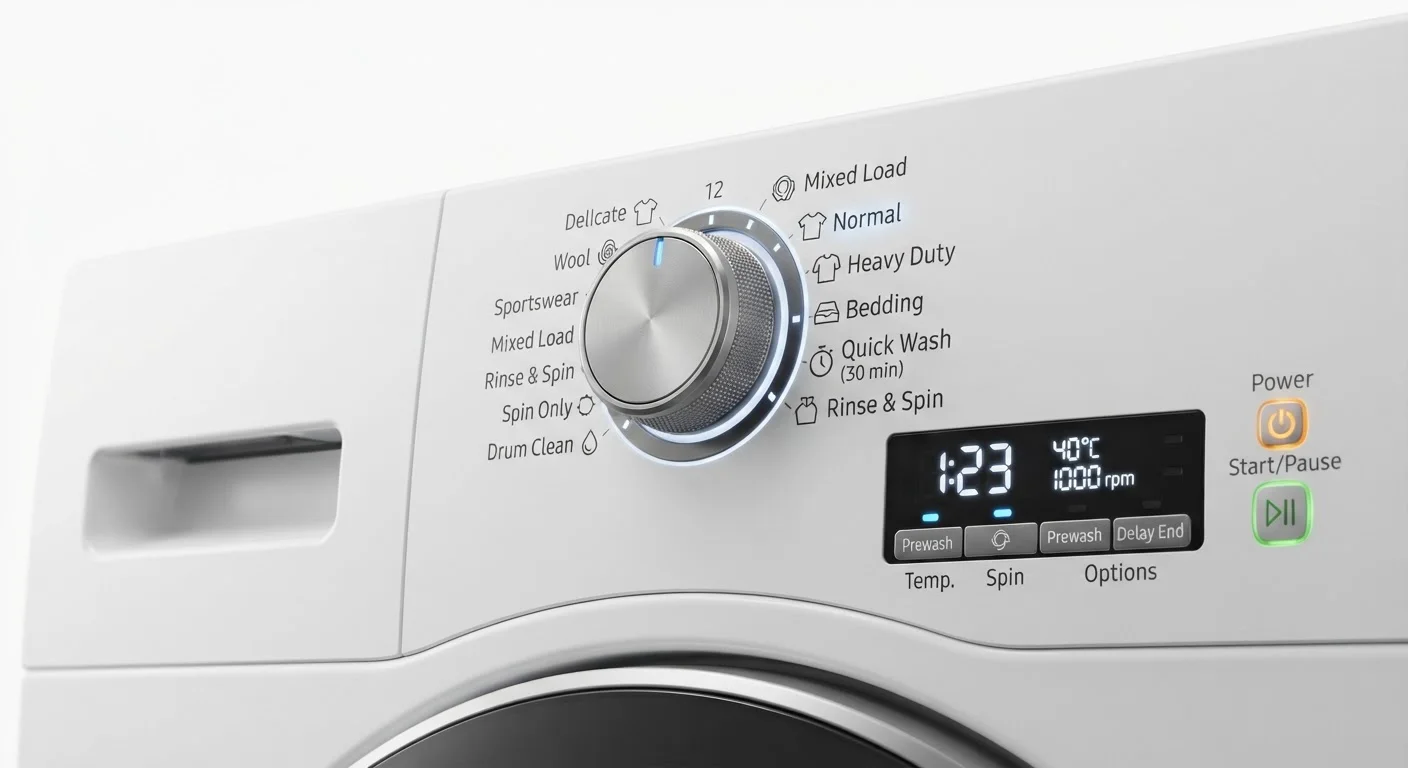
- Normal / Regular: Warm water, medium-to-high agitation, medium-high spin. Designed for everyday cotton and mixed synthetics. The workhorse setting for most household laundry.
- Delicate / Gentle: Cold or cool water, slow and minimal agitation, low spin speed. Intended for fragile fabrics — lace, silk blends, fine knits, or anything labeled 'hand wash.' The reduced drum motion limits fiber stress.
- Heavy Duty: Hot or warm water, extended high agitation, high spin speed. Suited for durable, heavily soiled items like work uniforms, canvas, thick cotton towels, and denim. Cycle duration is typically longer than Normal.
- Quick Wash / Speed Wash: Abbreviated wash and rinse times, reduced water volume. Effective only for lightly worn items with minimal soil. Not a replacement for full cycles on soiled loads — detergent contact time is insufficient.
- Permanent Press: Warm wash, cool rinse, medium spin. The cool rinse reduces heat-set wrinkles in synthetic blends and dress shirts before they are transferred to the dryer.
- Sanitize / Allergen: Very hot water (often above 140°F) with extended soak time. Designed to reduce allergens, bacteria, and dust mite residue. Not appropriate for most colored or delicate fabrics due to heat intensity.
Sort Before You Select a Cycle
Before choosing a cycle, sort your laundry into groups by fabric type and soil level — not just by color. Delicates, heavy cottons, and synthetics all behave differently under the same wash conditions. Sorting first means you can select one appropriate cycle per load rather than compromising with a single middle-ground setting for mismatched fabrics.
For a deeper look at how washer type affects these cycle mechanics, see our comparison of front-load and top-load washer designs.
Reading Care Labels Alongside Cycle Settings
Care labels — the small tags sewn into garments — are the manufacturer's instruction for how that specific fabric blend should be washed. They use standardized symbols and text to indicate maximum water temperature, whether machine washing is safe, and what agitation level is appropriate. Matching these instructions to your washer's available cycles is the most reliable way to avoid shrinkage, color loss, or structural damage.
A garment tagged 'gentle cycle only' maps directly to the Delicate setting. An item marked 'wash in cold water' should not go into a Normal or Heavy Duty cycle with warm or hot water, even if the soil level seems to warrant it. When in doubt, a cooler and gentler cycle will always be safer than a hotter or more aggressive one — you may need to rewash, but you cannot un-shrink a sweater.
Cycle Names Vary by Manufacturer
There is no industry-wide standard for cycle naming. One manufacturer's 'Casual' cycle may closely resemble another's 'Permanent Press.' When in doubt, consult your washer's user manual, which typically lists the water temperature, agitation level, and spin speed associated with each named cycle. This information is usually more precise than the label alone.
If you want to understand how the physical drum size of your washer affects how well cycles can actually perform, our guide on washer capacity and cubic foot ratings is worth reading alongside this one. For technical definitions of specs you may encounter, the laundry appliance specs glossary covers terminology in detail.