How the Cleaning Mechanisms Actually Differ
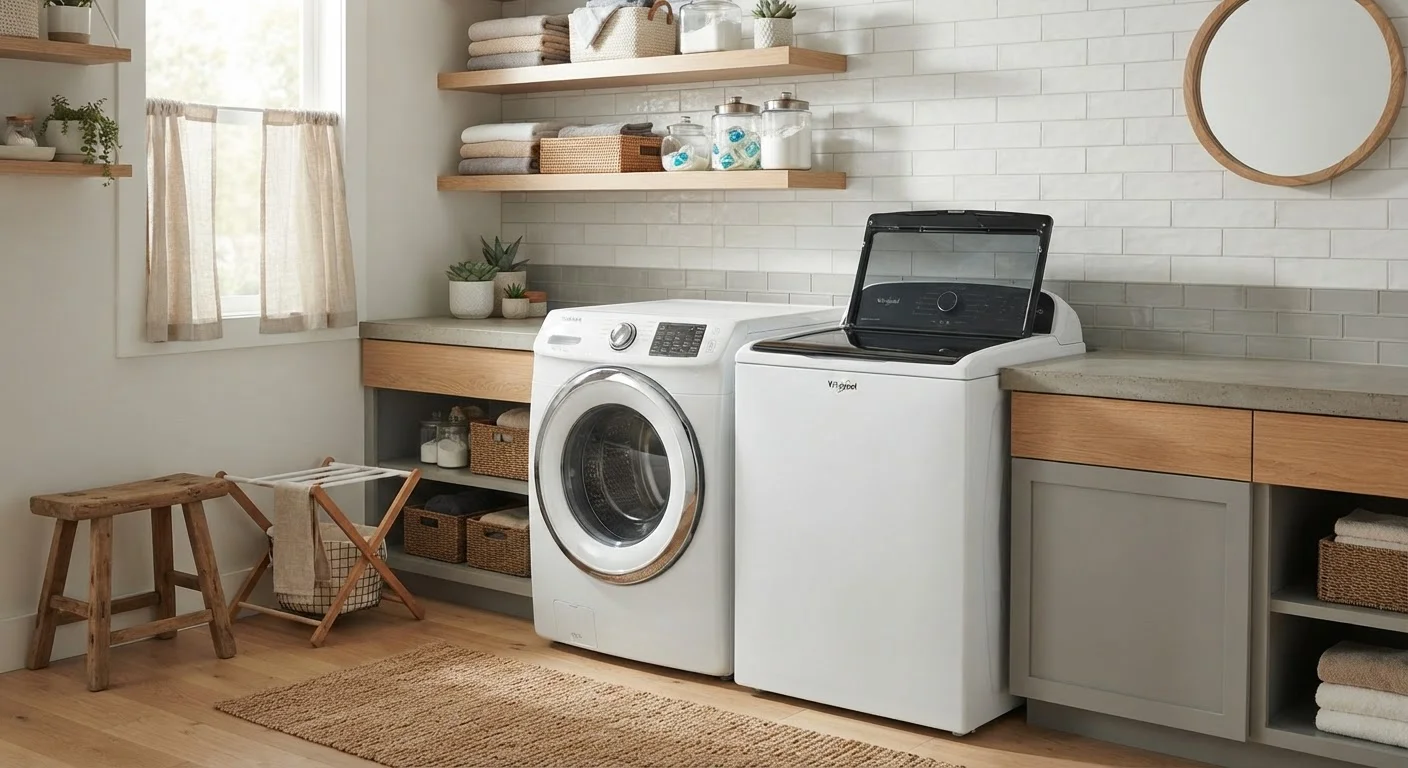
The most fundamental difference between front-load and top-load washers is how they move clothes through water. Front-loaders use a tumbling action: the drum rotates on a horizontal axis, repeatedly lifting and dropping garments through a smaller pool of water. Top-load agitator models use a central post that twists back and forth, dragging fabric through a fuller tub of water. High-efficiency (HE) top-loaders — which lack an agitator — use impellers, low-profile disc-shaped elements that create turbulent water currents to move clothes.
Tumbling is generally gentler on fabric fibers than agitation, making front-loaders a frequent choice for households with delicate garments. The cycle settings on each machine interact directly with these mechanical differences — a delicate cycle on a front-loader reduces tumble speed, while the same setting on an agitator top-loader simply slows the agitation stroke. Neither approach guarantees fabric safety on its own; garment care labels remain the authoritative guide.
| Criterion | Front-Load Washer | Top-Load Washer |
|---|---|---|
| Cleaning action | Tumbling (horizontal drum rotation) | Agitation or impeller (vertical axis) |
| Water use per cycle | Approx. 13–25 gallons | Approx. 20–45 gallons (type-dependent) |
| Typical spin speed | 1,000–1,400 RPM | 700–900 RPM |
| Stackable with dryer | Yes, with compatible stacking kit | No |
| Mid-cycle loading | Generally not supported | Supported on most models |
| Fabric gentleness | Generally gentler (no agitator) | Varies; agitator can stress fabrics |
| Drum-cleaning maintenance | Door gasket attention required | Less gasket concern; detergent buildup risk |
| Ergonomic access | Requires bending; pedestal can help | Top-access is easier for many users |
Water Use, Spin Speed, and Energy Considerations
Water consumption is one of the starkest measurable differences between the two types. Front-load washers are certified by the EPA's WaterSense program at much lower gallon-per-cycle figures than traditional top-load agitator machines. A conventional top-load agitator washer can use roughly 30–45 gallons per cycle, while front-loaders commonly use 13–25 gallons depending on load size and cycle selection. HE top-loaders fall in between, typically using less water than agitator models but more than comparably sized front-loaders.
Spin speed, expressed in RPM (revolutions per minute), determines how much water is extracted before clothes reach the dryer. Front-loaders routinely spin at 1,000–1,400 RPM; many top-loaders top out at 700–900 RPM. Higher spin speeds mean clothes emerge noticeably drier, which can reduce dryer run time. For a fuller explanation of specs like RPM and MEF (Modified Energy Factor), the laundry appliance specs glossary covers each metric in detail.
~45%
Less water used by front-loaders vs. agitator top-loaders
The EPA estimates that ENERGY STAR certified front-load washers can use significantly less water per cycle compared to conventional agitator top-loaders.
1,400 RPM
Maximum spin speed on high-end front-loaders
Higher RPM extracts more moisture before drying, which can reduce dryer energy consumption per cycle across a household's annual laundry volume.
~20%
Additional floor space saved by stacking
Stacking a front-load washer and dryer in a vertical configuration can free up meaningful floor area in compact laundry closets or utility rooms.
Capacity and Space Planning
Drum capacity is measured in cubic feet, and both washer types are available across a wide range of sizes — from compact 2.0 cu. ft. units to large-capacity models exceeding 5.0 cu. ft. The key distinction is how that interior volume is used. Without a central agitator, front-loaders and HE top-loaders tend to offer more usable drum space per cubic foot rating. Our guide on what cubic feet actually means for your laundry explains how to translate drum size into practical load sizing for different household sizes.
Space planning also involves the laundry room layout itself. Front-loaders can be stacked with a matching dryer using a stacking kit, which is a significant advantage in apartments, closets, or utility corridors. Top-loaders cannot be stacked. If you're evaluating side-by-side versus stacked configurations more broadly, the stacked vs. side-by-side laundry setups guide offers a structured look at how different arrangements affect clearances and daily usability.
Maintenance Differences Worth Knowing
Front-load washers require more attentive upkeep around the door gasket — the rubber seal around the opening. Because the drum lies horizontal and seals tightly, moisture can accumulate in the gasket folds, creating conditions where mildew can develop if the door is closed immediately after a wash. Leaving the door ajar after cycles and running a drum-cleaning cycle monthly are the standard recommendations for managing this. Some front-loaders include a self-clean or tub-clean cycle specifically for this purpose.
Top-loaders — particularly agitator models — don't share this gasket concern, and the open-top design allows the drum to air out naturally. However, HE top-loaders have their own maintenance needs: their low-water wash action means detergent residue can accumulate if non-HE or excessive amounts of detergent are used. Both washer types benefit from periodic drum cleaning, but the failure point differs. Before any new washer is delivered, it's also worth reviewing what to verify before delivery — hookup requirements, leveling surface needs, and doorway clearances vary between front- and top-load units.
HE Detergent Is Not Optional
Both front-load washers and HE top-load washers are designed to operate with high-efficiency (HE) detergent. Standard detergent produces excess suds that low-water wash cycles cannot fully rinse out, which can leave residue on clothes and inside the drum over time. HE detergent is formulated to clean effectively with less water and lower sudsing. Using the correct detergent type — and the recommended amount — is one of the simplest ways to extend the working life of either machine type.