How Each Configuration Uses Space
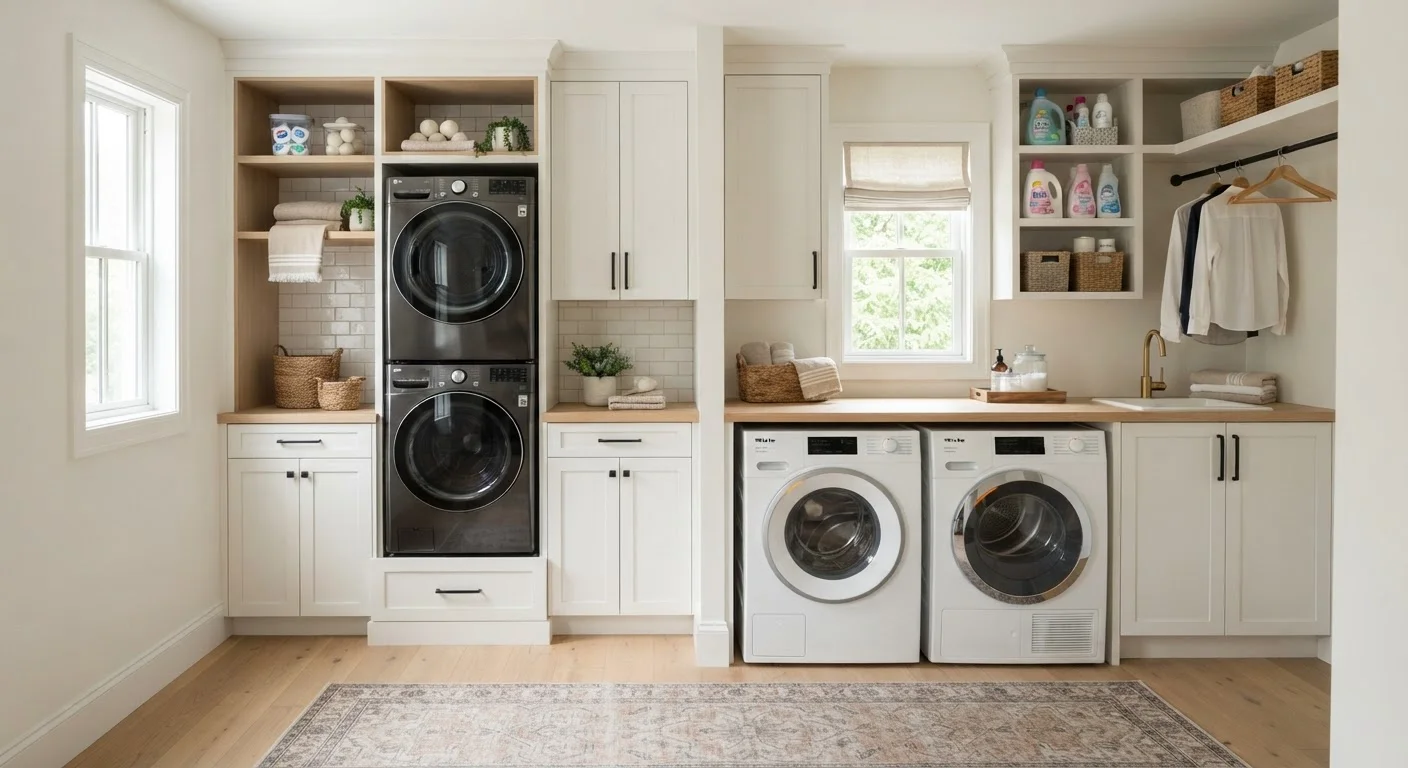
The most immediate difference between stacked and side-by-side laundry setups is how they occupy your floor plan. A stacked configuration places the dryer directly on top of the washer, using vertical height rather than horizontal width. A typical stacked pair occupies roughly 27–30 inches of width and around 70–75 inches in height, whereas a side-by-side arrangement of two full-size machines claims roughly 54–60 inches of floor width at a standard 36-inch height.
That floor-width difference is significant in smaller homes. Closet laundry installations — common in condos and older apartments — often measure 30–36 inches wide, making stacking the only practical option. In contrast, dedicated laundry rooms in single-family homes typically offer the floor area that side-by-side machines require, plus room for folding surfaces or storage.
It's worth distinguishing between two stacked configurations: a dedicated stackable pair (separate machines designed to be stacked with a connecting kit) and an all-in-one washer-dryer combo unit. The latter uses a single drum for both washing and drying, which further reduces footprint but also limits load size and cycle control. Front-load vs. top-load washer differences are also relevant here — stacking requires front-loading machines exclusively, since top-loaders cannot be stacked safely.
| Criterion | Stacked Setup | Side-by-Side Setup |
|---|---|---|
| Floor width required | ~27–30 inches | ~54–60 inches |
| Height | ~70–75 inches | ~36 inches |
| Machine type required | Front-load only | Front-load or top-load |
| Typical drum capacity (washer) | 2.3–4.5 cu. ft. | 4.5–5.8 cu. ft. |
| Simultaneous wash + dry | Not possible (combo units) | Yes, independently |
| Independent replacement | Limited by compatibility | Yes, freely |
| Ventless dryer compatibility | Common and practical | Available, less common |
| Loading ergonomics | Low washer, high dryer | Consistent mid-level access |
Capacity, Cycles, and Appliance Specs
Drum capacity is where side-by-side setups tend to hold a practical advantage. Full-size front-load washers commonly range from 4.5 to 5.8 cubic feet, while stackable washers are often found in the 2.3–4.5 cubic foot range. For households doing heavy laundry volumes — large families, bulky bedding, or frequent use — that capacity gap is meaningful. The relationship between drum capacity and real laundry loads is worth understanding before committing to either layout.
Cycle variety is less dependent on configuration than on the specific model chosen. Both stacked and side-by-side machines now commonly offer steam cycles, allergen settings, and sensor-based drying. The configuration itself doesn't restrict cycle options — your appliance tier and budget do.
~30 in.
Minimum floor width for a stacked pair
Most standard stackable washer-dryer pairs require approximately 27–30 inches of floor width, based on common manufacturer dimension specifications.
5.8 cu. ft.
Upper range for full-size front-load washer capacity
Full-size front-load washers available for side-by-side installation commonly reach up to 5.8 cubic feet, according to widely published appliance specification data.
~75 in.
Typical stacked unit total height
A stacked washer-dryer pair with a connecting kit typically reaches 70–75 inches tall, requiring adequate ceiling clearance in the installation space.
One practical note: in a side-by-side setup, you can run the washer and dryer simultaneously on separate loads. With an all-in-one combo unit, washing and drying occur sequentially in the same drum, which extends total cycle time considerably for back-to-back loads.
Ventilation, Utility Hookups, and Installation Constraints
Both configurations require the same core utilities — a 120V or 240V electrical outlet (depending on whether the dryer is electric or gas), a water supply line, and a drain. What differs is how ventilation and hookup placement affect feasibility.
Vented dryers — whether stacked or side-by-side — require an exhaust duct routed to an exterior wall. In a stacked setup, the dryer sits higher, which can complicate duct routing if the exhaust port doesn't align easily with your existing vent path. Ventless condenser or heat-pump dryers sidestep this constraint and are commonly paired with stacked configurations in spaces where exterior venting isn't practical. However, ventless dryers generally have longer cycle times and may require periodic lint filter and condenser cleaning.
Ventless Dryers: A Closet-Friendly Option
Condenser and heat-pump dryers don't require an exterior exhaust duct, making them well-suited for interior closet or apartment installations. Heat-pump dryers, in particular, are more energy-efficient than vented models but carry a higher upfront cost. Cycle times for ventless units are generally longer — often 50–90 minutes for a standard load — so factor that into your household's laundry routine before choosing this path.
Before deciding on a configuration, confirm the location of your water supply, drain outlet, and electrical panel relative to your intended laundry space. These positions significantly narrow your installation options. The pre-delivery verification checklist for washers and dryers covers utility and clearance requirements in detail.
Ergonomics, Maintenance, and Long-Term Practicality
Ergonomics are a genuine differentiator between the two layouts. In a side-by-side setup, both machines load at roughly the same height — typically requiring a slight forward bend for front-loaders, which can be offset with optional pedestal risers. A stacked configuration places the dryer at chest-to-eye level (generally easier) while the washer sits at floor level (requiring a deeper bend or squat for every load). Over time, that low-loading posture can become a meaningful inconvenience, particularly for older adults or anyone with back or mobility limitations.
Maintenance access also differs. In a side-by-side arrangement, both machines are independently accessible from three sides. In a stacked installation — especially in a closet — accessing the rear for hose checks or lint trap maintenance can be more awkward. Additionally, if one machine in a stackable pair fails, servicing may require fully destacking both units.
From a long-term flexibility standpoint, side-by-side setups allow you to replace the washer or dryer independently when one reaches end of life. Stacked pairs — particularly dedicated stackable models — often share a stacking kit from the same manufacturer, meaning mismatched replacements may not be compatible. This is worth factoring into the total cost of ownership over a decade or more of use. For a broader perspective on evaluating appliance specs before purchase, see our guidance on what to look for before bringing an appliance home.