Why Air Fryer Myths Spread So Quickly
Air fryers became one of the fastest-adopted kitchen appliances in recent American households, and with that surge in popularity came an equally fast spread of misinformation. Marketing language, social media cooking videos, and word-of-mouth enthusiasm all contributed to a set of beliefs about air fryers that range from mildly misleading to genuinely incorrect.
Getting the facts straight matters not just for cooking results, but for making a sound purchase decision and using the appliance safely. Just as nutrition myths refuse to die despite clear evidence, air fryer misconceptions have proven similarly stubborn. Below, we work through the most common ones.
Myth
Air fryers cook food without any oil, making everything completely fat-free.
Fact
Air fryers require little oil compared to deep frying, but most foods still benefit from at least a light coating of oil for proper browning and texture.
The "oil-free" claim is one of the most pervasive misconceptions about air fryers. While you can technically cook certain high-fat foods — like chicken thighs or bacon — without added oil, lean proteins, vegetables, and starchy foods typically produce better texture and flavor with a small amount of oil applied. The reduction in oil compared to deep frying is real and meaningful, but conflating "less oil" with "no oil" sets inaccurate expectations and can result in dry, unevenly cooked food.
Myth
Air fryers cause cancer because they produce dangerous levels of acrylamide.
Fact
Acrylamide forms when starchy foods are cooked at high temperatures through any dry-heat method — not specifically in air fryers.
Acrylamide is a chemical compound that forms naturally in starchy foods during high-temperature cooking via a reaction between sugars and the amino acid asparagine. It can form in oven-roasted potatoes, deep-fried foods, and toasted bread just as readily as in an air fryer. Regulatory agencies including the U.S. Food and Drug Administration acknowledge acrylamide as a concern in the food supply generally and advise cooking starchy foods to a light golden color rather than dark brown — a guideline that applies to all cooking methods, not air fryers alone.
Myth
An air fryer always cooks food faster than a conventional oven.
Fact
Air fryers preheat faster and can cook small batches quickly, but cooking time depends heavily on food volume, density, and basket capacity.
For small portions, the air fryer's compact chamber and high-speed airflow do typically reduce cook time. However, because of the limited basket size, cooking larger quantities requires multiple batches, which can make total meal preparation time longer than a full-size oven. Thick, dense items also still require adequate dwell time at temperature to cook through safely, regardless of the appliance. Claiming universal speed superiority ignores these practical constraints.
Myth
Air fryers can fully replace a conventional oven for all cooking tasks.
Fact
Air fryers excel in specific use cases but lack the capacity, moisture control, and even heat distribution of a full-size oven for many tasks.
An air fryer is a complement to, not a substitute for, a conventional oven in most households. Large roasts, multi-rack baking, recipes requiring steam or precise humidity control, and dishes in standard baking pans generally exceed what a countertop air fryer can accommodate or replicate. For everyday small-batch cooking and reheating, the air fryer is highly capable — but framing it as a complete oven replacement leads to frustration when it inevitably falls short on certain recipes.
Myth
You can put any kitchen container or wrapping into an air fryer.
Fact
Only materials rated for high convection heat — such as oven-safe metal, ceramic, or certain silicone — should be used inside an air fryer basket.
Because an air fryer operates at temperatures comparable to a conventional oven (often 350–400°F or higher), materials that cannot tolerate oven heat should never be placed inside. Plastic containers, standard paper plates, and non-oven-rated glass can warp, melt, or shatter. Even parchment paper should be weighted down with food so it doesn't contact the heating element. Always verify that any accessory or container is explicitly rated for the temperatures your air fryer reaches.
What Air Fryers Actually Do Well — And Where They Fall Short
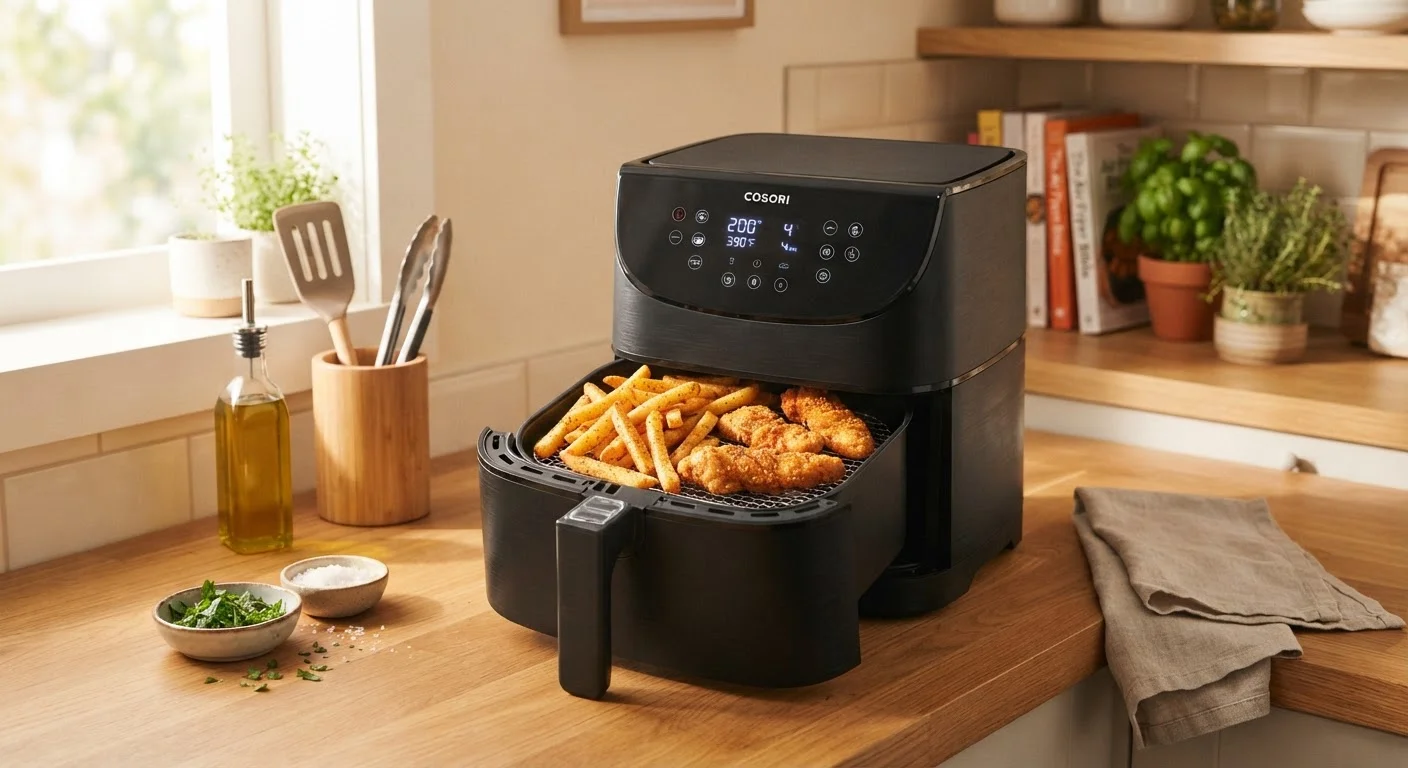
Understanding the real physics of an air fryer helps set realistic expectations. These appliances use a powerful convection fan to circulate superheated air around food at high speed, producing a browned, crispy exterior through the Maillard reaction — the same process behind oven roasting and pan frying. That mechanism is genuinely effective for many foods, particularly those that benefit from dry, high heat: chicken pieces, frozen vegetables, thin-cut potatoes, and breaded items.
Where air fryers consistently underperform is in tasks requiring moisture retention — braising, steaming, or cooking large dense cuts of meat evenly. Delicate baked goods that depend on precise, gentle heat distribution can also suffer. The confined basket and intense airflow that make the appliance efficient for some foods create challenges for others.
~75%
Reduction in oil use vs. deep frying
Food science researchers generally estimate that air frying can reduce added fat by up to 75% compared to traditional deep frying, though results vary by food type and recipe.
3–5 min
Typical air fryer preheat time
Most countertop air fryer models reach cooking temperature in roughly 3 to 5 minutes, compared to 10–15 minutes for a standard full-size oven.
Recognizing these real-world boundaries allows home cooks to get genuine value from the appliance rather than disappointment from unmet expectations. If you enjoy debunking appliance and lifestyle myths, the same evidence-first approach applies to topics like car maintenance myths — where conventional wisdom also frequently overrides fact.
Never Leave an Air Fryer Unattended at High Heat
Air fryers cycle at high temperatures and can quickly overheat certain foods or non-rated materials, posing a fire risk. Keep the appliance on a heat-safe, stable surface away from cabinetry and never place it directly under overhead cabinets while in use. Always follow the manufacturer's safety guidelines for your specific model.