How Each Type of Microwave Actually Heats Food
The word "microwave" describes a specific heating mechanism: the appliance emits electromagnetic waves at a frequency that causes water molecules inside food to vibrate rapidly, generating heat from within the food itself. This is why a standard microwave can bring a bowl of soup to a boil in under two minutes — it's directly agitating the moisture already present in the food.
What electromagnetic heating cannot do is produce dry surface heat. Without a separate heat source, the outside of food stays moist rather than browning or crisping. That's a physical limitation, not a power or quality issue — it's simply how the technology works.
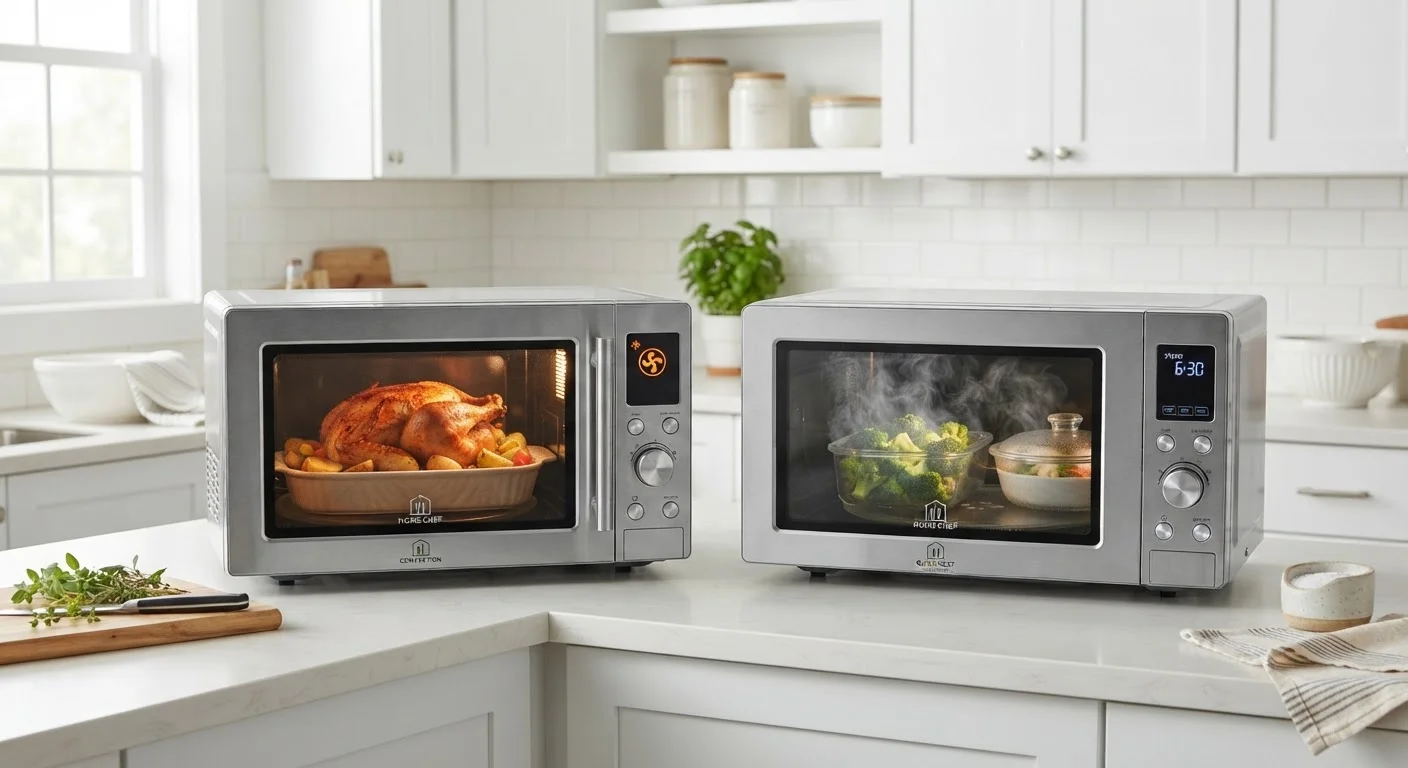
A convection microwave incorporates a resistive heating element and a fan inside the cavity. When convection mode is active, the fan circulates hot air around the food in the same way a convection oven does. This dry, moving air draws moisture away from the food's surface and creates the Maillard reaction — the browning process responsible for crispy chicken skin, golden pastry, and roasted vegetables with caramelized edges. Many convection microwaves also allow both modes to run simultaneously, which speeds up cooking while still delivering surface browning.
For a plain-English breakdown of other microwave specifications — including wattage and sensor cooking — see our microwave feature glossary.
| Criterion | Convection Microwave | Standard Microwave |
|---|---|---|
| Heating method | Microwaves + circulating hot air | Microwaves only |
| Browning and crisping | Yes, via convection mode | No |
| Baking capability | Yes, within cavity size limits | No |
| Reheating speed | Standard (preheat may add time) | Fast |
| Defrosting | Yes | Yes |
| Typical price range | Higher | Lower |
| Learning curve | Moderate (multiple modes) | Low |
| Can substitute for a conventional oven | Partially, for many tasks | No |
Where Each Appliance Performs Best — and Falls Short
Standard microwaves handle a narrow but frequently needed set of tasks with unmatched efficiency: reheating refrigerated meals, steaming vegetables, defrosting frozen proteins, boiling water, and melting butter or chocolate. For these tasks, a convection microwave offers no practical advantage and may actually be slower because some convection models require a short preheat cycle before reaching operating temperature.
Convection microwaves justify their higher cost and added complexity when the cooking goal involves texture. Roasting a half chicken, baking a small batch of cookies, crisping frozen appetizers, or reheating pizza to a genuinely crisp crust — these outcomes fall outside what electromagnetic heating alone can deliver. In compact living spaces, a convection microwave can plausibly serve as a primary oven for everyday meals, reducing reliance on a full-size range.
~25–50%
Typical price premium for convection models
Convection microwaves generally carry a meaningful price premium over comparable standard models at similar wattages, reflecting the added heating element and fan components.
1.0–1.5 cu ft
Typical convection microwave cavity size
Most countertop convection microwaves fall in this interior volume range, which is smaller than the cavity in a standard 30-inch wall oven.
One underappreciated limitation of convection microwaves: cavity size is typically smaller than a countertop or wall oven, and the round turntable design can make it awkward to fit standard rectangular baking pans. Anyone planning to use the convection function regularly should verify usable interior dimensions against their typical cookware before purchasing.
If you're evaluating countertop appliances more broadly, the checklist in our guide on what to look for in a countertop appliance covers footprint, wattage, and other factors that apply across categories.
Making the Right Choice for Your Kitchen
The decision between a convection and standard microwave comes down to two straightforward questions: how often will you cook versus merely reheat, and how much kitchen space or budget do you have to work with?
For most households that already own a conventional oven, a standard microwave handles the daily supporting role — warming, defrosting, simple steam cooking — with less complexity and lower cost. Adding a convection microwave on top of a full-size oven creates genuine redundancy rather than added capability for most cooking styles.
Households without a full oven, those doing significant countertop cooking, or renters in furnished spaces where oven access is limited will find convection microwaves considerably more useful. The ability to brown and bake changes the category from a reheating tool into a genuine cooking appliance.
New to setting up a kitchen overall? Our introduction to kitchen appliances for first-time buyers can help you think through how microwaves fit alongside other appliances in a prioritized, budget-conscious way.
Combination Mode: The Best of Both?
Many convection microwaves offer a simultaneous combination mode that runs microwave and convection heat at the same time. This can significantly reduce overall cook time compared to convection-only heat while still achieving surface browning. If you're considering a convection model, check whether the combination mode is available and how easily it can be activated — some units make this more intuitive than others.