Why Microwave Spec Sheets Feel Confusing
Microwave shopping tends to stall the moment you hit the spec sheet. Wattage figures, sensor labels, inverter technology, and convection modes pile up fast — and retailers rarely explain what any of it means for your daily cooking. This glossary cuts through that noise.
Each entry below defines a common microwave term in plain English, explains what it actually does inside the appliance, and notes when a given feature is worth caring about. If you're starting from scratch on kitchen appliances more broadly, this grounded introduction for first-time buyers is a useful starting point before diving into individual feature comparisons.
| Typical consumer wattage range | 600 – 1,200 watts |
| Common interior capacity range | 0.7 – 2.2 cubic feet |
| Sensor cooking mechanism | Humidity / steam detection |
| Inverter advantage | Continuous low-power delivery vs. on/off cycling |
| Convection mode function | Adds hot-air circulation for browning |
| CFM relevance | Over-the-range models only |
Core Feature Definitions
The terms below represent the features you're most likely to encounter on a microwave's product page or packaging.
Wattage
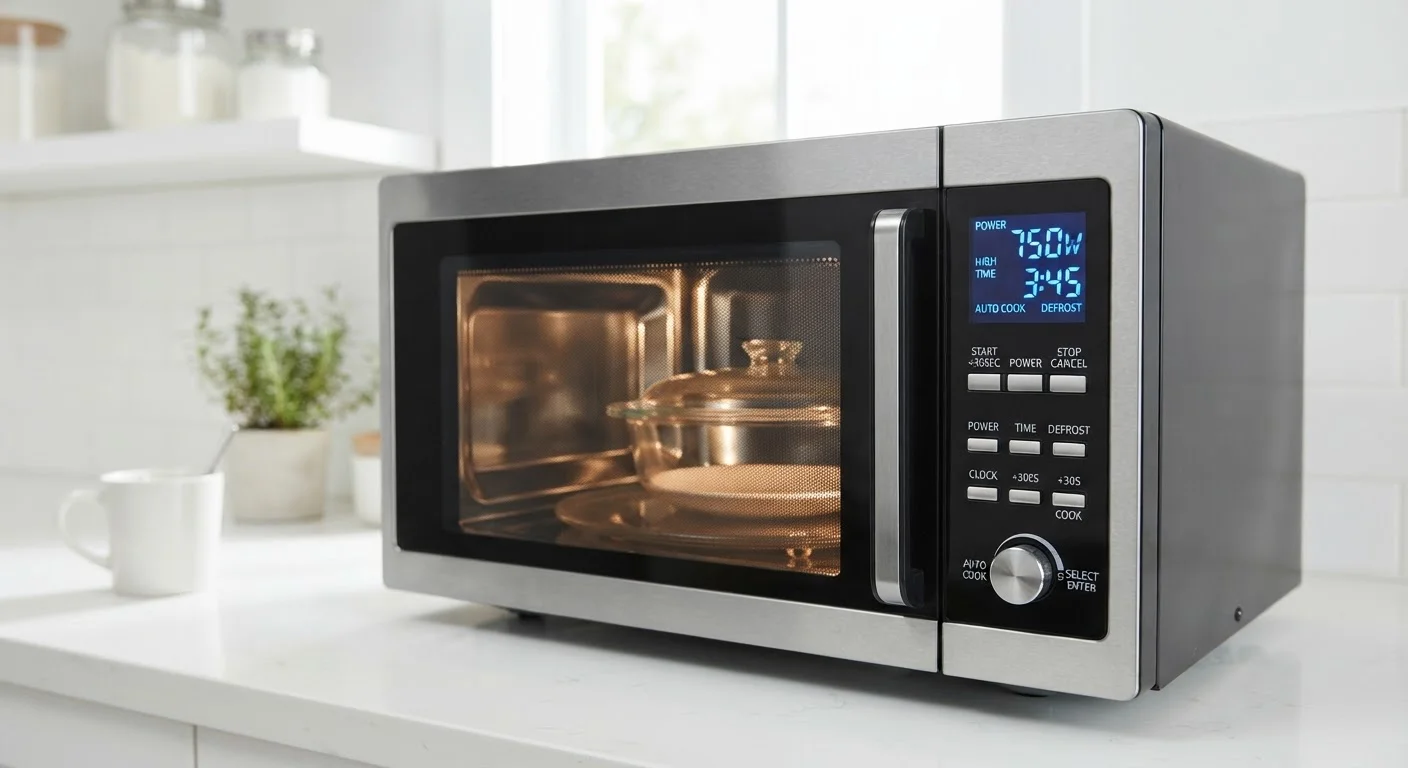
The output power of the microwave's magnetron, measured in watts. Higher wattage generally means faster, more even cooking. Consumer countertop models typically range from about 600 to 1,200 watts.
Magnetron
The core component that generates microwave radiation inside the appliance. It converts electrical energy into electromagnetic waves that agitate water molecules in food, producing heat.
Turntable
A rotating glass or ceramic plate on the floor of the microwave cavity. It moves food through the microwave field to promote more even heating and reduce hot and cold spots.
Flatbed (or Turntable-Free) Design
An alternative to the rotating turntable that uses a bottom-mounted rotating antenna instead. The cavity floor stays stationary, making it easier to fit large or irregular-shaped dishes.
Sensor Cooking
A technology that uses humidity sensors to detect steam released by food as it heats. The microwave adjusts cooking time and power automatically based on the detected moisture level, stopping when the food appears done.
Inverter Technology
A power-delivery system that provides continuous, regulated energy at lower power levels rather than cycling the magnetron on and off. It produces more even cooking at reduced settings, particularly useful for defrosting and simmering.
Convection Mode
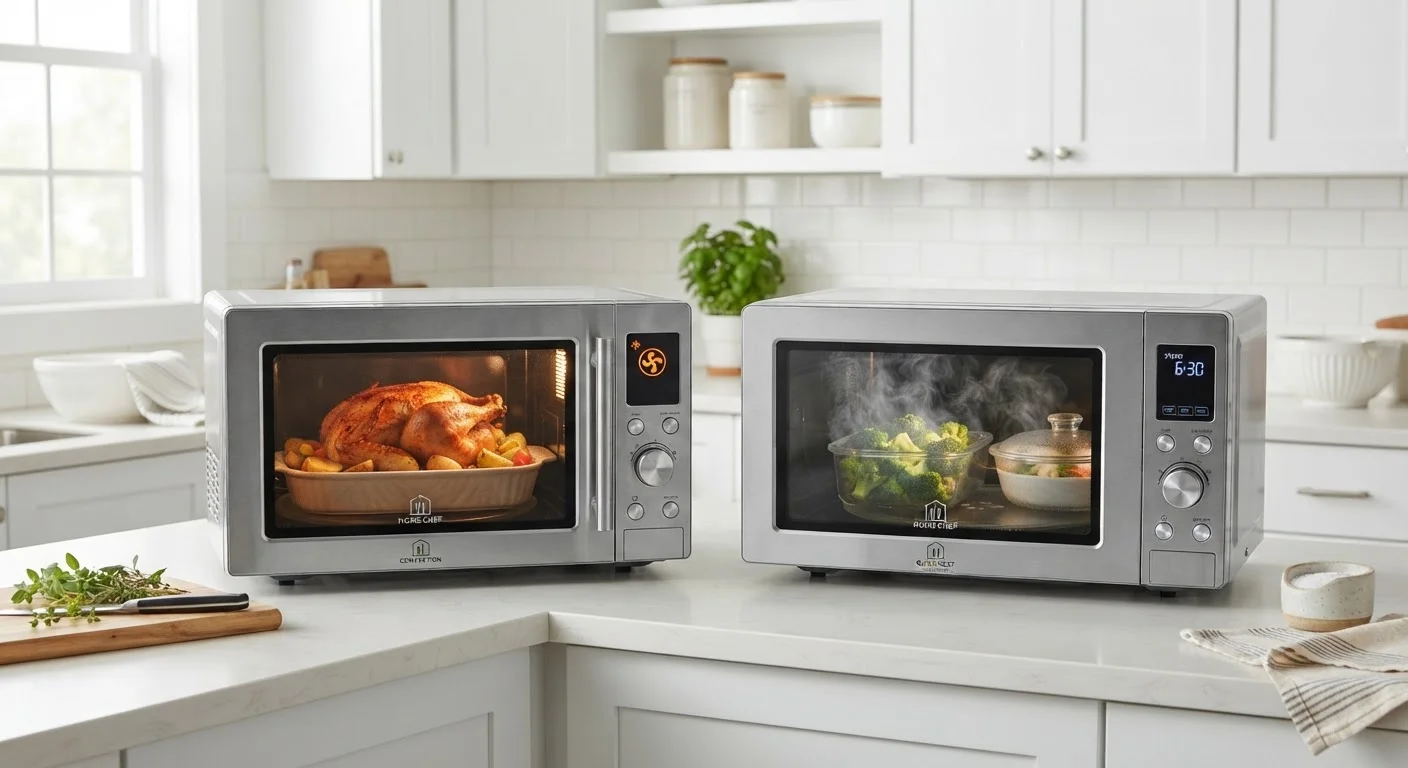
An additional cooking function found on some microwaves that uses a heating element and fan to circulate hot air — similar to a conventional oven. This allows browning and crisping that standard microwave radiation alone cannot achieve.
CFM (Cubic Feet per Minute)
A ventilation measurement relevant to over-the-range microwaves. It describes how much air the built-in exhaust fan can move per minute, affecting how well cooking odors and steam are cleared from the cooktop below.
Power Level
A user-selectable setting, usually expressed as a percentage (e.g., 50% power), that controls how much of the magnetron's full output is applied. On non-inverter models, this is achieved by cycling power on and off in timed intervals.
Cubic Foot Capacity
The interior volume of the microwave cavity, measured in cubic feet. It determines what size dishes fit inside. Compact models typically start around 0.7 cu. ft.; full-size countertop units commonly range from 1.0 to 2.2 cu. ft.
Express Cook / Auto Cook
Pre-programmed shortcuts that set a specific time and power level for common tasks (e.g., reheating a beverage or cooking popcorn) at the touch of a button. Accuracy varies by model and food brand.
Child Lock
A control panel lockout feature that disables the microwave's buttons to prevent unintended or unsupervised operation, typically activated by holding a specific button for several seconds.
If you're comparing a convection microwave against a standard model, this side-by-side breakdown covers how heat transfer differs between the two types.
What These Features Mean in Practice
Knowing the definition of a feature and knowing when it matters are two different things. Here's how the most common microwave specs translate to real-world outcomes:
- Wattage and cooking speed: A 1,000-watt microwave heats food roughly 25% faster than a 700-watt unit on the same setting. For reheating leftovers, the difference is noticeable. For melting butter or softening cream cheese, it's significant — higher wattage makes precision more demanding.
- Turntable vs. flatbed: Turntable microwaves work well for most round or square containers. Flatbed models (which replace the rotating plate with a bottom-mounted antenna) accommodate larger, irregular dishes more easily and eliminate the common problem of containers catching on the tray edge.
- Sensor cooking reliability: Sensor programs perform most consistently with foods that release steam predictably — vegetables, soups, and similar items. Results can vary with dense or very dry foods that emit little moisture.
- Inverter vs. cycling magnetron: Traditional microwaves cycle their magnetron on and off to simulate lower power — meaning defrost mode alternates between full power and off. An inverter microwave delivers genuinely continuous low power, which produces more even defrosting with less partially cooked surface area.
~25%
Faster heating: 1,000W vs. 700W
A general estimate based on microwave physics; actual results vary by food type, starting temperature, and container.
0.7–2.2 cu. ft.
Typical countertop interior capacity range
Reflects the range commonly published in manufacturer specifications for consumer countertop microwave models.
For a broader checklist of what to evaluate before purchasing any countertop appliance, see what to look for in a countertop appliance.
Features Worth Prioritizing — and Features That Aren't
Not every feature on a microwave spec sheet has equal impact on everyday performance. Wattage, interior capacity, and power-level accuracy tend to matter most for consistent cooking results. Sensor cooking adds genuine convenience for households that frequently reheat steam-emitting foods. Convection capability meaningfully expands what the appliance can do — though it comes with a steeper learning curve and a higher price point.
Features like pre-programmed auto-cook shortcuts (dedicated buttons for popcorn, pizza, or beverages) are convenient but rarely calibrated well enough to replace manual adjustment. Decorative interior lighting and extra-quiet door latches are quality-of-life touches rather than performance factors.
Understanding which terms reflect core cooking ability — versus which are marketing framing — is the difference between finding an appliance that matches your household's actual use and paying a premium for labels that don't change results. For comparison, the same kind of spec-decoding process applies to laundry appliances; this laundry spec glossary breaks down washer and dryer terminology in the same format.