What the Dryer Is Actually Telling You
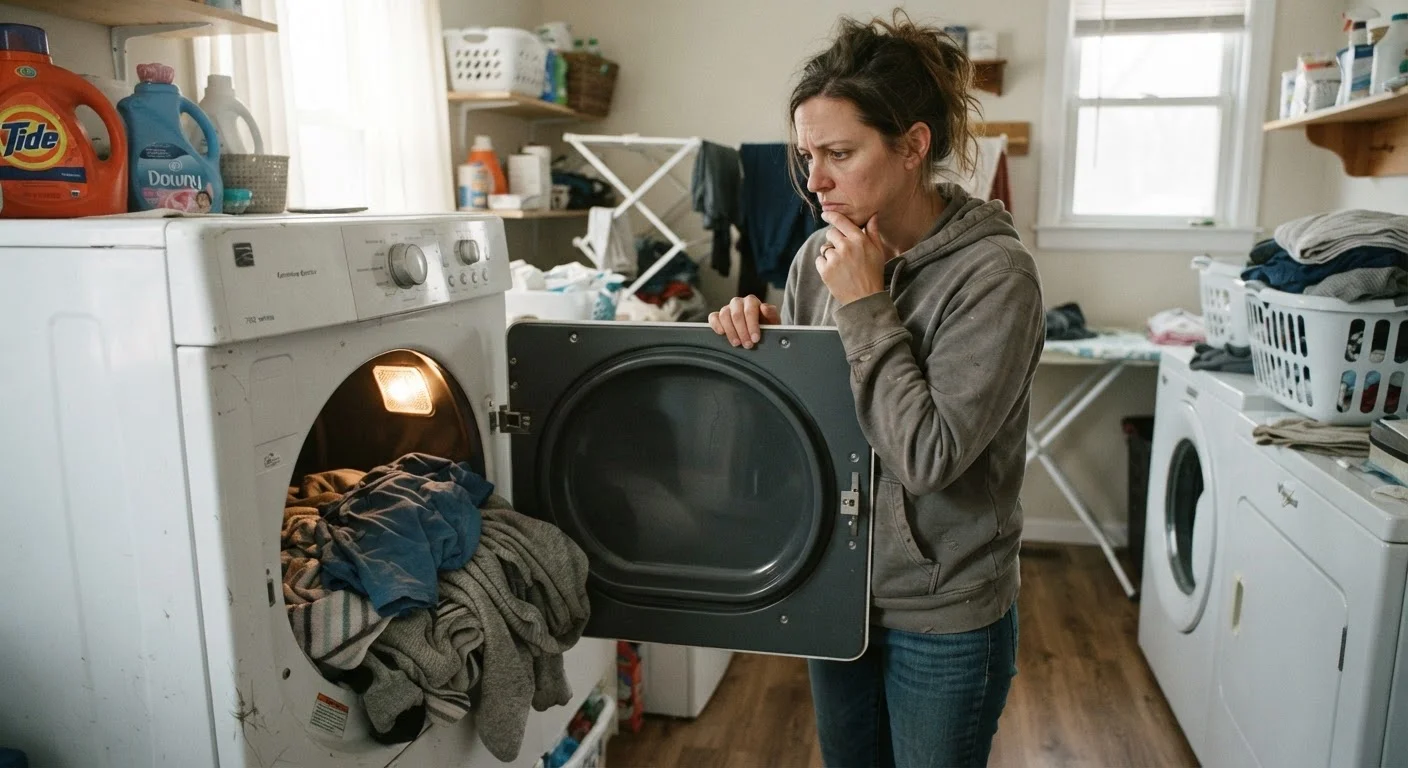
When clothes come out damp after a full cycle, the dryer is almost always flagging an underlying condition — not simply failing at random. Dryers remove moisture through a combination of heat, tumbling action, and airflow. If any one of those three elements is compromised, the result is predictable: wet laundry that has been tumbled but not truly dried.
Understanding the mechanics helps you diagnose accurately. Most modern dryers use either a timed cycle or a sensor-based cycle. In a sensor cycle, metal strips inside the drum detect electrical conductivity from moisture in the fabric; when the reading drops below a set threshold, the machine stops. In a timed cycle, the machine simply runs for the duration you select. Both designs have distinct failure points — and knowing which type you have is the first step toward a fix. See our guide to laundry appliance specs for a detailed breakdown of moisture sensor technology and other dryer terminology.
Common Mistakes That Leave Laundry Damp
The following errors account for the overwhelming majority of incomplete drying — and each one is correctable without replacing the appliance.
Overloading the dryer drum with too many items at once.
Why it happens: Drum capacity ratings are often misunderstood — a large cubic-foot drum is not a license to transfer an entire washer load in one shot. Fabrics need room to tumble freely so heated air can circulate between them.
Running a high-heat cycle on fabrics that require low or medium heat settings.
Why it happens: It may seem counterintuitive, but high heat can cause the outer layer of some synthetic fabrics to set before internal moisture escapes, leaving garments that feel dry on the surface but damp inside.
Neglecting the lint trap before every load.
Why it happens: Many users clean the lint trap only when it looks visibly full. Even a partially blocked screen restricts airflow significantly, reducing the efficiency of every cycle that follows.
Ignoring a clogged or kinked exhaust vent duct.
Why it happens: Exhaust ducts collect lint over time and can also become crimped if the dryer is pushed too close to the wall. A restricted duct traps humid air inside the drum, preventing efficient moisture removal.
Allowing moisture sensor bars to become coated with dryer sheet residue.
Why it happens: Dryer sheet softeners leave a thin film on sensor bars over time. This film insulates the metal strips, causing them to read the load as drier than it actually is and shutting the cycle off too early.
Blocked Vents Are a Fire Hazard
A heavily clogged dryer exhaust duct does more than reduce drying performance — it creates a genuine fire risk. Lint is highly flammable, and restricted airflow causes heat to build up inside the duct and dryer housing. The U.S. Fire Administration has identified dryer vent clogs as a leading cause of home dryer fires. If your dryer is running hot to the touch, emitting a burning smell, or taking multiple cycles to dry a single load, stop using it and inspect or service the exhaust duct before continuing.
When the Problem Is the Washer, Not the Dryer
A dryer can only remove so much moisture per cycle. If clothes arrive from the washer with unusually high water retention, the dryer is effectively starting from behind. This situation is more common than many people expect.
400–1,200 RPM
Typical washer spin speed range
Washers with higher spin speeds extract significantly more water before transfer, reducing dryer workload according to appliance industry specifications.
~35%
Estimated U.S. home energy use for laundry
The U.S. Department of Energy notes that clothes dryers account for a meaningful portion of household energy consumption, making efficiency issues worth addressing promptly.
Front-load and high-efficiency top-load washers are generally rated by their Integrated Water Factor (IWF) — a measure of how much water remains in the load after the spin cycle. A washer with a high IWF score leaves laundry wetter than one with a low score, and the dryer must compensate. If your spin cycle seems short or your load arrives in a dense, soaking clump, it may be worth evaluating whether the washer's spin speed (measured in RPM) is appropriate for the load type. Our pre-delivery checklist for laundry appliances also covers utility hookup considerations that affect both machines' performance from day one.