Why Vacuum Specs Are Confusing by Design
Walk through any appliance aisle or scroll through an online listing and you'll encounter a mix of wattage ratings, Pascal figures, filtration grades, and brush roll types — often presented without context. Manufacturers highlight the metrics that favor their products, which means the numbers you see most prominently aren't always the most useful ones for making a real-world evaluation.
Understanding what each specification actually measures — and what it doesn't — helps you compare models on terms that matter for your specific floors, household, and cleaning habits. Just as appliance terminology in other categories rewards some baseline literacy (see our laundry appliance specs guide for a parallel example), vacuum specs respond well to a careful read.
0.3 µm
Smallest particle size HEPA must capture
HEPA filters are tested at 0.3 microns because that size is the most difficult for filters to trap — a standard established by the U.S. Department of Energy.
99.97%
HEPA minimum capture efficiency
To carry the HEPA designation under U.S. standards, a filter must trap at least 99.97% of particles at the 0.3-micron test size.
CFM
Airflow unit used in vacuum ratings
Cubic feet per minute (CFM) measures air volume throughput and is widely considered one of the most practical suction performance indicators by appliance engineers.
Suction Power: The Metrics That Actually Matter
Wattage is the spec consumers see most often, but it measures electrical consumption — not cleaning output. A 2,000-watt motor running an inefficient design can underperform a 1,200-watt motor in a well-engineered one.
Two metrics more directly tied to cleaning performance are:
- Airflow (CFM — cubic feet per minute): Measures the volume of air pulled through the vacuum. Higher CFM is particularly important for picking up light debris like pet hair and fine dust across open floor areas.
- Suction pressure (Pa or water lift): Measures how forcefully the vacuum pulls air when the path is restricted — such as through thick carpet pile or a partially clogged filter. Expressed in Pascals (Pa) or inches of water lift.
Neither metric alone is definitive. A vacuum with high airflow but low suction pressure may struggle on dense carpet. One with high suction pressure but low airflow may miss debris on open surfaces. The most informative listings report both.
Filtration: What the Grades Mean
Filtration specs describe how thoroughly a vacuum traps particles before exhausting air back into the room. The most commonly cited standard is HEPA (High-Efficiency Particulate Air), which requires capturing at least 99.97% of particles at 0.3 microns in size under laboratory test conditions.
However, the filter grade is only half the story. A vacuum with a genuine HEPA filter installed in an unsealed housing can still exhaust unfiltered air through gaps in the casing. This is why "sealed system" or "sealed HEPA" language matters — it indicates that all air is forced through the filter rather than leaking around it.
Sealed System vs. Filter Grade: Know the Difference
A high-grade filter installed in an unsealed vacuum housing may allow air to leak around the filter rather than through it, bypassing filtration entirely. When allergen capture is a priority — such as in households with asthma or pet dander concerns — look for explicit "sealed system" or "sealed HEPA" labeling in addition to the filter grade itself. These are separate and both matter.
Filter maintenance is also a practical consideration. A clogged filter restricts airflow and reduces suction over time. Our guide on cleaning appliance maintenance covers how filter replacement schedules affect long-term performance. For a deeper look at exactly what HEPA certification guarantees, see what the HEPA label actually guarantees.
Brush Rolls: What They Do and When to Avoid Them
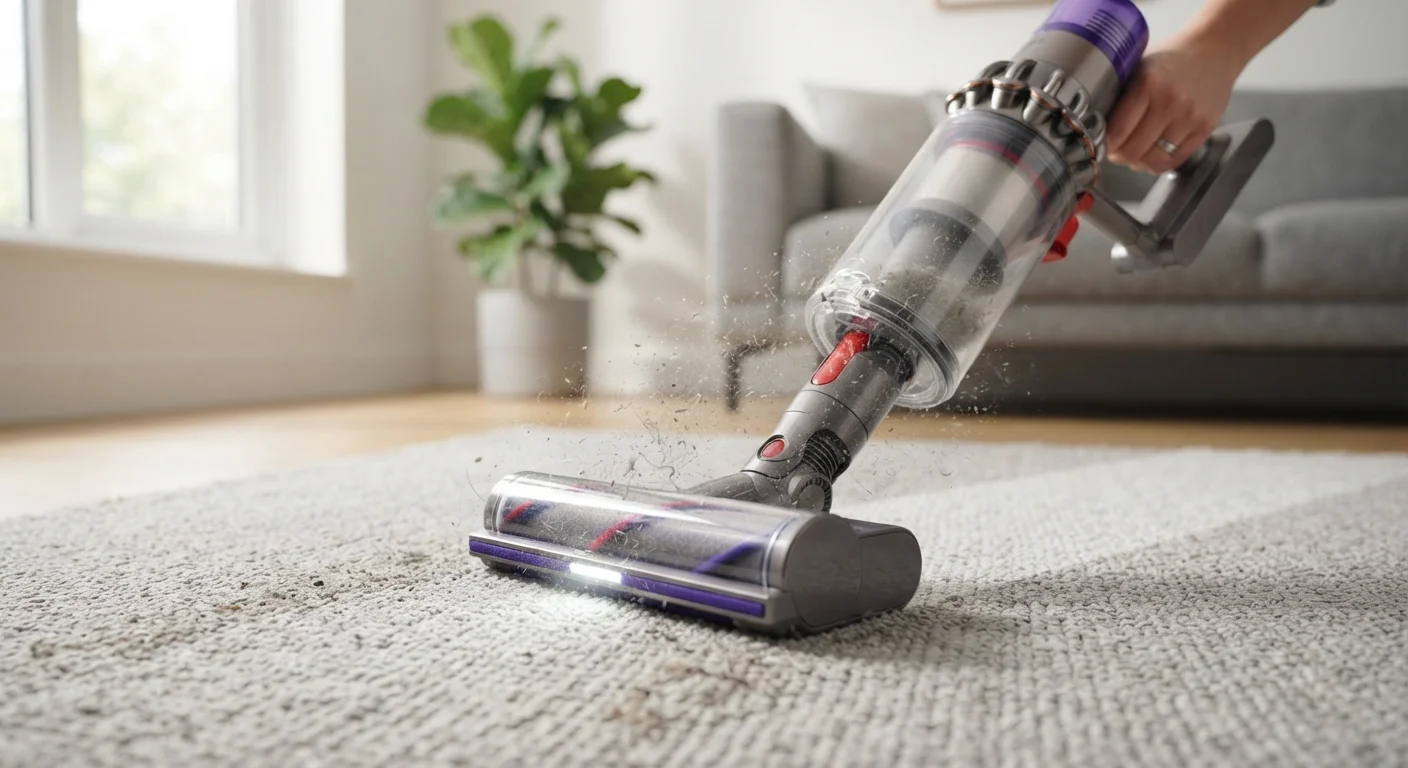
A brush roll (also called a beater bar or agitator) is a rotating cylinder with bristles that physically agitates carpet fibers, dislodging embedded soil and debris so the suction system can remove it. On carpeted surfaces, this mechanical action meaningfully improves deep-clean results compared to suction alone.
On hard floors, however, a spinning brush roll can scatter lightweight debris rather than capturing it, and abrasive bristles may scratch delicate surfaces like hardwood or luxury vinyl plank. Most current vacuum designs address this with a brush roll on/off switch or a dedicated hard floor mode.
Check for a Brush Roll Switch Before Buying
If your home includes both carpeted and hard floor areas, confirm that the vacuum you're evaluating has a brush roll on/off control or interchangeable floor heads. Running an aggressive carpet brush roll on hardwood or tile can scatter debris and potentially damage the surface finish over repeated use.
Brush roll materials and design also vary. Stiffer nylon bristles perform well on short-pile carpet; softer, velvety roller heads are engineered for hard floors. Some models include interchangeable heads for different surface types. If your home includes a mix of carpet and hard flooring, this flexibility is worth evaluating. For a broader look at matching cleaning tools to hard floor surfaces, see choosing a cleaning appliance for hard floors.
Reading Specs in Context
No single spec predicts overall vacuum performance. A useful spec sheet review considers how the metrics interact: a vacuum with strong suction pressure, adequate airflow, a sealed HEPA system, and the right brush roll configuration for your floor types is likely to perform well across typical household conditions.
Vacuums aren't the only cleaning appliance category where spec literacy pays off. If you use both a vacuum and a mop in your routine, understanding how different cleaning tools approach hard floors can help you avoid redundancy — our comparison of steam, spin, and spray mops covers the key distinctions.