Why Maintenance Frequency Matters More Than You Think
Cleaning appliances are asked to do repetitive, high-load work — pulling debris through narrow passages, filtering fine particles, and spinning bristles across abrasive surfaces. Unlike most household items, they degrade incrementally in ways that aren't always obvious until performance drops sharply.
The cumulative effect of skipped maintenance is rarely a single catastrophic failure. More often, it's a slow erosion: suction weakens, filters become restrictive, motors run hotter, and the appliance simply stops doing what it was designed to do. Understanding which components are most vulnerable — and on what timeline — is the foundation of keeping any cleaning appliance effective.
For a deeper look at how neglect patterns apply across appliance categories, see why countertop appliances stop working early.
Up to 40%
Suction loss from a clogged filter
Engineering tests on bagless vacuums consistently show airflow restriction of this magnitude when filters go uncleaned beyond manufacturer-recommended intervals.
2–3x
Motor wear increase from brush roll tangles
Appliance repair professionals note that drive belt and motor failures are significantly more common in vacuums with chronically tangled brush rolls compared to well-maintained units.
The Components That Actually Degrade — and How to Address Them
Not every maintenance task carries equal weight. These are the components that most directly affect performance and lifespan:
Clean or replace filters on a condition-based schedule, not just a calendar one.
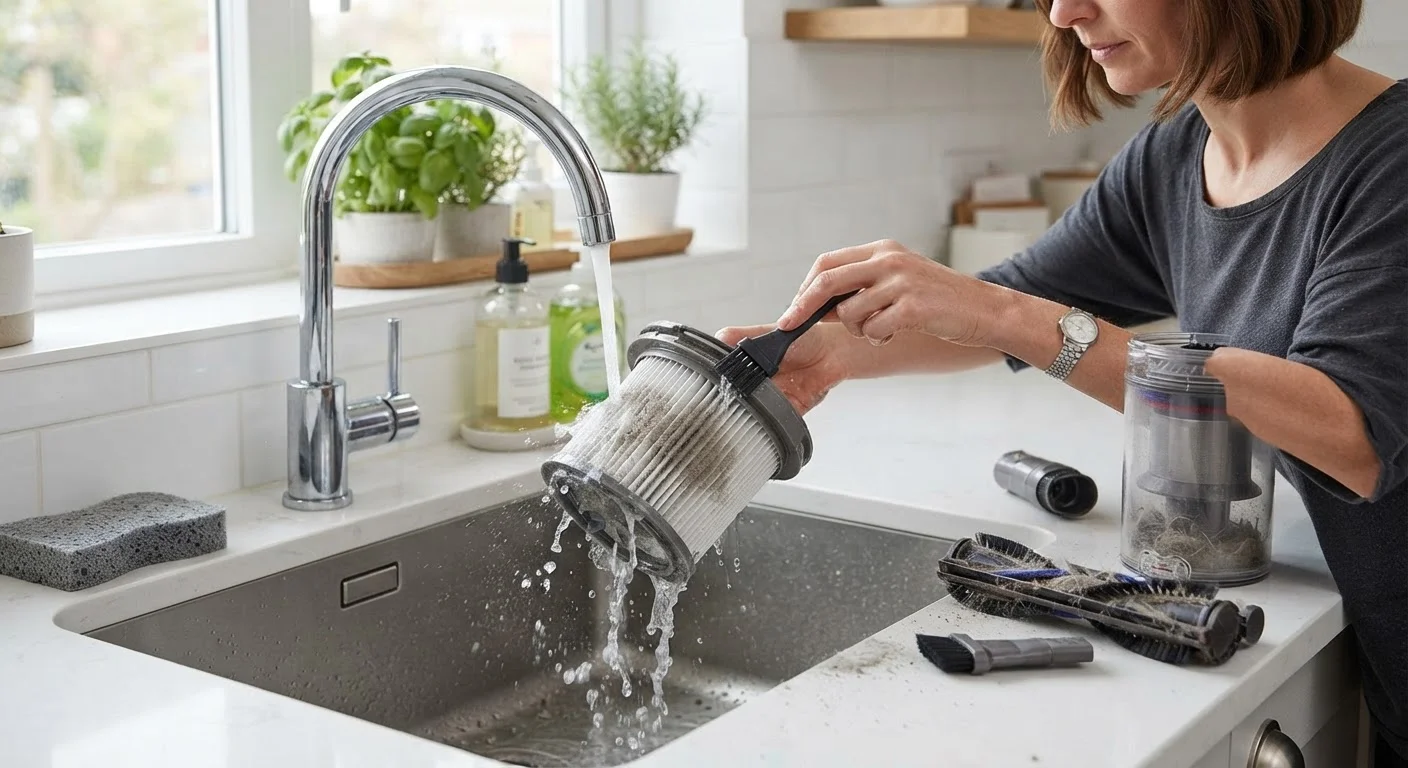
Filters are the most restrictive point in any vacuum or air-cleaning appliance's airflow path. A clogged filter forces the motor to work harder, generating excess heat and reducing suction measurably. Foam and felt pre-filters can typically be rinsed and dried; HEPA-style filters may need full replacement once airflow restriction becomes noticeable.
Remove brush roll tangles after every few uses, especially in homes with long hair or carpet.
Hair, thread, and fibers wrap around brush rolls progressively, eventually preventing the roll from spinning freely. A restricted brush roll reduces agitation on carpet pile and can overheat the drive belt. Most brush rolls can be accessed by removing a panel and cutting away debris with scissors.
Empty dustbins and canisters when they reach half to two-thirds capacity.
Waiting until a bin is completely full reduces suction before you even realize it — debris compresses and airflow is restricted well before the bin looks overloaded. Emptying earlier maintains consistent suction and reduces the chance of fine dust re-entering the motor pathway.
Inspect door seals and gaskets on wet-dry vacuums and steam mops periodically.
Seals degrade from heat cycling and chemical exposure without producing obvious symptoms. A compromised seal on a wet-dry vacuum can allow water ingress into the motor housing; a failed steam mop seal reduces steam pressure and cleaning effectiveness. Visual inspection every few months catches cracking or flattening before it becomes a functional problem.
Wipe sensor windows and charging contacts on robot vacuums monthly.
Robot vacuums navigate using optical and infrared sensors that become obscured by dust accumulation. Dirty sensors cause navigation errors, missed zones, and unnecessary recharging cycles. Charging contacts coated in dust or oxidation prevent reliable docking.
What You Can Reasonably Skip
Not everything labeled as maintenance is equally critical. Many appliance owners over-maintain some parts while neglecting the ones that genuinely matter.
Deep-cleaning the exterior housing, for instance, has no meaningful impact on function. Similarly, replacing consumable parts on a fixed calendar rather than based on observed condition can lead to unnecessary expense. A filter that still passes airflow adequately doesn't need replacing simply because three months have elapsed.
When Manufacturer Schedules Are Worth Following
Replacement intervals in owner's manuals are based on engineering data about component wear under typical use conditions — they're not arbitrary. That said, 'typical use' varies significantly. A household with pets, high foot traffic, or construction dust nearby should expect shorter effective filter and brush roll lifespans than the manual assumes. Use the schedule as a baseline, then adjust based on what you observe during inspections.
The goal is condition-based attention, not ritual maintenance. Check components, evaluate their actual state, and act accordingly. For vacuums specifically, understanding what filtration specifications mean in practice can sharpen those judgment calls — what the HEPA label on your vacuum actually guarantees is a useful starting point.
Quick-Start: Actions Worth Taking Today
If your cleaning appliances haven't received attention in a while, these are the highest-impact places to start — no tools required for most of them.
Once you've addressed immediate maintenance needs, building a simple habit around these checks — roughly once a month for high-use appliances — prevents the gradual performance decline that often goes unnoticed until the machine stops working well. If your robot vacuum has been missing the same areas repeatedly, it's worth reviewing sensor and brush roll condition; see why your robot vacuum keeps missing the same spots for a detailed breakdown.