What the HEPA Standard Actually Requires
HEPA — High Efficiency Particulate Air — is a performance standard, not a product category or material type. A filter qualifies as HEPA when it captures at least 99.97% of airborne particles measuring 0.3 microns in diameter during a standardized test. That specific size, known as the Most Penetrating Particle Size (MPPS), is used precisely because it represents the hardest particles to trap: both smaller and larger particles are actually captured at higher rates.
The standard was developed in the mid-20th century for industrial and nuclear applications before becoming common in consumer products. In home vacuums, the term has grown into marketing shorthand — sometimes applied rigorously, sometimes loosely. Understanding what the standard requires helps you evaluate claims rather than simply trust the label.
99.97%
Minimum particle capture rate for true HEPA
The U.S. Department of Energy established this benchmark: a HEPA filter must capture at least 99.97% of airborne particles at 0.3 microns in diameter.
0.3 µm
Most penetrating particle size (MPPS)
Particles at 0.3 microns are the hardest to capture, making this the standard test size; HEPA filters are actually more efficient at capturing both larger and smaller particles.
Common HEPA Misconceptions, Corrected
Most confusion about HEPA vacuums comes from a handful of persistent myths. The distinctions below clarify what the filter actually does — and what it doesn't.
Myth
Any vacuum with 'HEPA' printed on the box meets the same verified standard.
Fact
Only vacuums explicitly certified to the HEPA standard must capture 99.97% of particles at 0.3 microns; unverified uses of the term carry no legal minimum.
In the United States, the term 'HEPA' is not uniformly regulated on consumer vacuum packaging. Manufacturers may use it loosely to describe any high-efficiency filter — even those with capture rates well below the 99.97% threshold. True HEPA certification, as defined by the U.S. Department of Energy for air purification contexts, requires 99.97% efficiency at 0.3 microns. Shoppers should look for explicit language such as 'True HEPA' or a stated filtration efficiency rating, rather than treating the label alone as meaningful.
Myth
A HEPA filter in a vacuum means the vacuum itself doesn't leak particles.
Fact
The filter's rating only applies to air passing through the filter media; gaps in seals, hoses, or the machine housing can bypass the filter entirely.
Think of a vacuum as a system of connected parts: motor, dustbin, hoses, seals, and the filter. Even a laboratory-grade filter is rendered ineffective if air can escape around it. This concept — sometimes called 'whole-machine' or 'sealed' filtration — describes how well a vacuum traps particles across its entire airpath. A model marketed as a 'sealed HEPA system' has been designed so that air must pass through the filter before being exhausted. Without that designation, the HEPA filter inside may still allow fine particulates to escape through poorly fitted joints or worn gaskets.
Myth
HEPA filters never need replacing as long as you tap the dust out periodically.
Fact
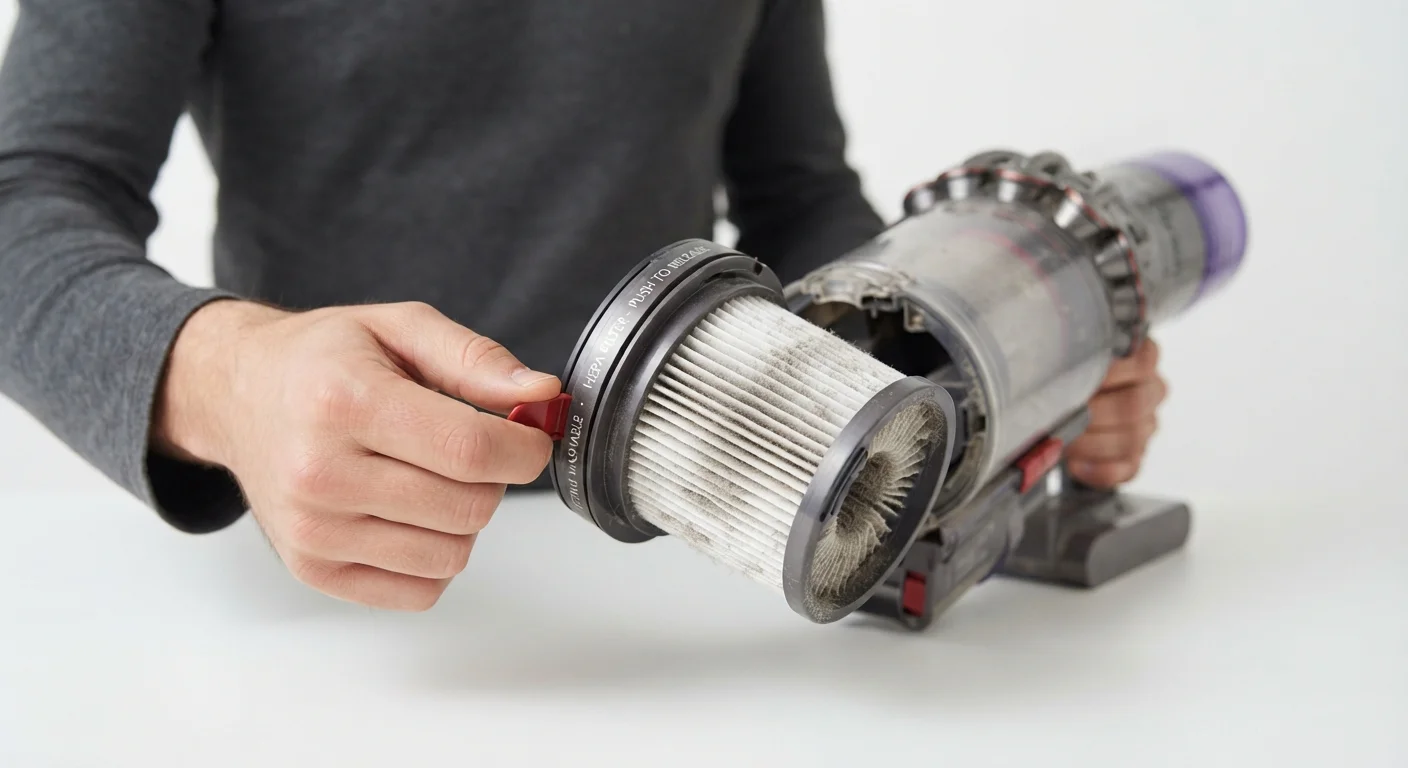
HEPA filters are designed for replacement on a schedule; washing or tapping them can damage the filter media and reduce capture efficiency.
The dense fiber matrix that gives HEPA filters their effectiveness is not meant to be washed or aggressively cleaned in most cases. Tapping or rinsing can degrade fiber alignment, creating pathways that allow particles to pass through unfiltered. Most manufacturers specify replacement intervals — commonly every 6 to 12 months depending on usage. Filters that appear visually clean may still be clogged at the microscopic level, reducing airflow and suction. For guidance on maintaining your vacuum's filter and other components, see maintenance practices that preserve vacuum performance.
Myth
HEPA filtration removes all indoor air pollutants, including odors and gases.
Fact
HEPA filters capture solid particulates only; gases, volatile organic compounds, and odors pass through the filter media unaffected.
HEPA technology is a mechanical filtration method: fibers physically trap particles as air moves through them. This works well for dust, pollen, pet dander, mold spores, and similar solid matter. However, gaseous pollutants — including odors, smoke compounds, formaldehyde, and volatile organic compounds (VOCs) — are molecular in nature and are not captured by fiber media. Activated carbon filters, which some vacuums include alongside HEPA, address a portion of these gases. If odor elimination or gas filtration is a priority, verify that a vacuum includes activated carbon or similar chemical filtration in addition to its HEPA filter.
Myth
Higher suction power makes HEPA filtration more effective.
Fact
Suction power and filtration efficiency are separate specifications; high suction with poor sealing can actually increase particle bypass.
Suction power determines how well a vacuum lifts debris from surfaces, while filtration efficiency determines what happens to fine particles once they're airborne inside the machine. These are independent variables. In fact, a powerful motor can create pressure differentials that force air through any weak point in the machine's housing, potentially worsening particle leakage if the system isn't properly sealed. For a deeper look at how these specifications interact, the guide to vacuum specs breaks down what each number on a spec sheet actually measures in practice.
Watch Out for 'HEPA-Type' Marketing Language
Terms such as 'HEPA-style,' 'HEPA-like,' and 'HEPA-type' are marketing descriptors, not certifications. These filters are typically less efficient than true HEPA and have no standardized minimum capture rate. If air quality is a genuine concern in your home, verify that the product explicitly states it meets the HEPA standard at 99.97% efficiency for 0.3-micron particles.
What to Actually Look For When Evaluating a Vacuum's Filtration
When filtration quality matters in your household — whether due to allergies, asthma, or pets — focus on two things beyond the HEPA label. First, confirm the stated filtration efficiency; reputable manufacturers cite the specific percentage and particle size. Second, look for evidence of whole-machine sealing, meaning the entire airpath is designed to prevent bypass. Some manufacturers submit their vacuums for third-party testing that evaluates emission performance at the machine level, not just the filter in isolation.
Sealed System vs. Filter Rating: A Critical Difference
A vacuum can contain a genuine HEPA-rated filter and still expel fine particles back into the air if the machine's housing and seals are not airtight. Always check whether a vacuum is marketed as a 'sealed HEPA system,' meaning the entire airpath — not just the filter — is designed to prevent bypass. This distinction is especially relevant for households managing allergies or asthma.
Filter replacement schedules are equally important. A certified HEPA filter operating past its useful life provides diminishing returns as fiber loading increases and airflow is restricted. Establishing a regular maintenance routine — including filter checks — is a fundamental part of keeping any vacuum performing as its specifications describe.