How Each Vacuum Type Works
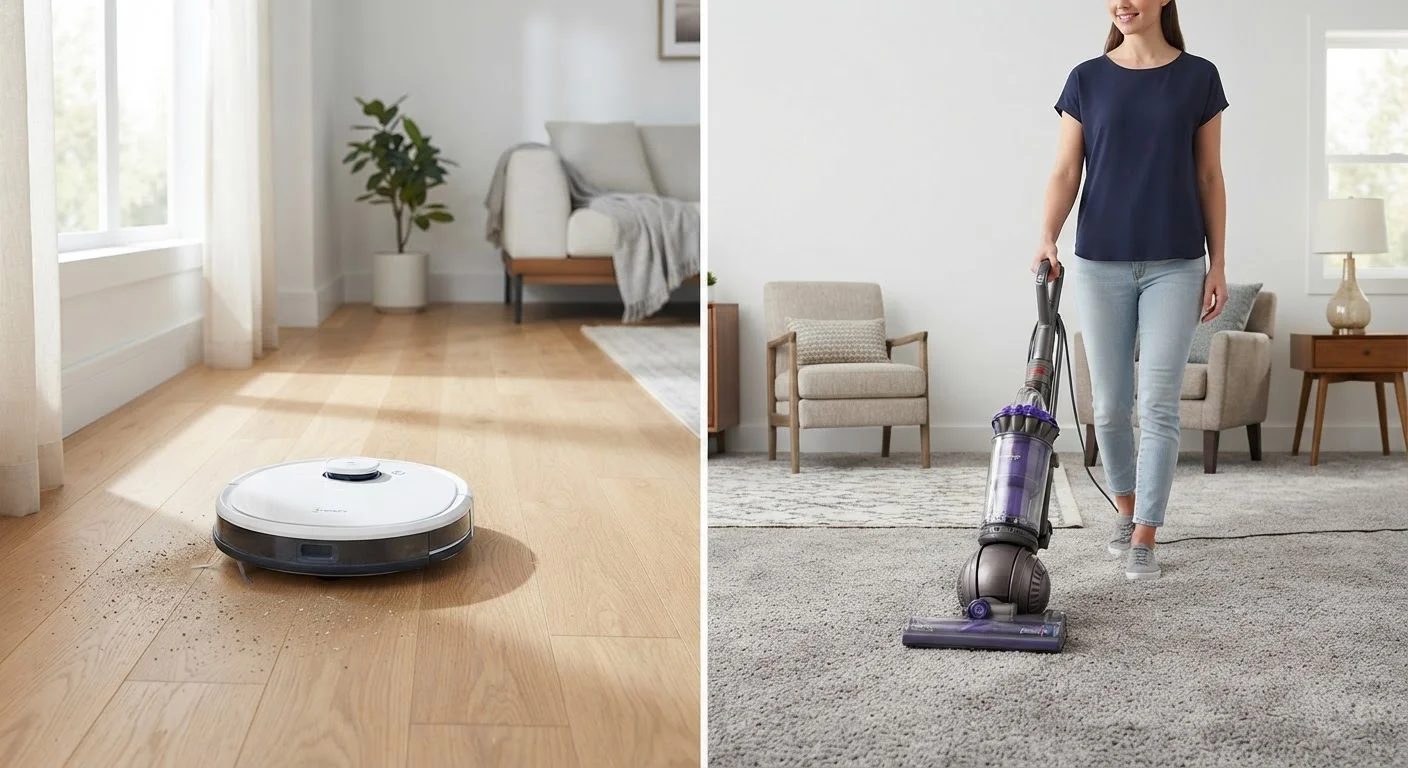
Understanding how these two appliances operate is the first step toward choosing the right one. A robot vacuum is a compact, disc-shaped device that navigates your home autonomously using sensors and, in many models, laser or camera-based mapping technology. It moves in systematic or reactive patterns, collecting dust and debris into a small onboard bin, then returns to its charging dock when finished or when battery runs low.
An upright vacuum, by contrast, is a full-sized, user-operated appliance. You push it across floors while its motorized brush roll agitates carpet fibers or hard surfaces, with suction pulling debris into a canister or bag. Upright models typically offer a range of attachments — crevice tools, upholstery brushes, and extension wands — for cleaning furniture, stairs, and tight corners.
For a deeper look at what vacuum specifications like suction power and filtration actually mean in practice, see our guide to vacuum specs.
| Criterion | Robot Vacuum | Upright Vacuum |
|---|---|---|
| Operation | Autonomous, scheduled | Manual, user-directed |
| Suction power | Moderate | High |
| Carpet performance | Basic to moderate | Strong, including deep pile |
| Hard floor performance | Strong | Strong with right attachment |
| Stair cleaning | Not capable | Capable with attachments |
| Cleaning consistency | High (scheduled runs) | Depends on user frequency |
| Physical effort required | Minimal | Moderate |
| Upholstery/furniture cleaning | Limited | Yes, via attachments |
| Typical bin/bag capacity | Small (0.3–0.7L) | Larger (1–3L) |
Cleaning Performance: Depth vs. Consistency
Upright vacuums hold a clear advantage in raw cleaning power. Their larger motors and direct-contact brush rolls can dislodge and extract dirt embedded deep in carpet pile — something robot vacuums, with their compact motors and smaller intake paths, generally cannot replicate. On high-pile rugs or heavily trafficked areas, this performance gap is tangible.
Robot vacuums, however, win on consistency. When scheduled daily or every other day, they prevent the gradual buildup of surface debris, pet hair, and dust — meaning your floors rarely reach the point where intensive deep cleaning is urgent. Think of them as a daily sweep rather than a thorough scrub.
~100 min
Average robot vacuum run time per charge
Most mid-range robot vacuums offer between 60 and 120 minutes of runtime before requiring a recharge, depending on cleaning mode and floor type.
~20%
Homes using robot vacuums as primary cleaner
Consumer research suggests a minority of robot vacuum owners rely on them exclusively, with most using them alongside a traditional vacuum.
2–4 Pa
Typical suction difference (upright vs. robot)
Upright vacuums commonly deliver suction in the range of 15,000–25,000 Pa, while many robot vacuums operate between 2,000–6,000 Pa — a meaningful gap for embedded dirt.
One meaningful limitation: robot vacuums struggle with cluttered rooms, raised thresholds, and certain furniture legs. Sensor blind spots and mapping errors can cause missed areas, particularly near walls and corners. Our article on why robot vacuums miss the same spots explains how layout choices and room prep can address this.
Floor Types, Home Size, and Layout Considerations
Floor composition plays a significant role in determining which vacuum serves you better. On hard floors — hardwood, tile, and laminate — robot vacuums perform competitively. Their low-profile suction works well on smooth surfaces, and they can cover large open areas without user effort. Our hard floor appliance breakdown covers additional factors worth considering if hard floors dominate your home.
On carpet, upright vacuums are more effective, particularly for medium to high pile. The motorized brush roll agitates fibers to release embedded particles, and higher suction ratings generally translate to more thorough results.
Home size and layout also matter. Large, open-plan spaces with minimal furniture obstacles are ideal robot vacuum territory. Multi-level homes present a challenge — most robot vacuums cannot navigate stairs independently, meaning you'd still need a secondary vacuum for upper floors. Upright vacuums handle multi-level homes without complication, though carrying them between floors requires physical effort.
Consider a Two-Vacuum Household Strategy
Many households find that robot and upright vacuums are more complementary than competitive. A robot vacuum handles day-to-day surface maintenance on hard floors and low-pile carpet, while an upright vacuum is brought out weekly or biweekly for deeper cleaning sessions, stair care, and upholstery. If your budget allows, this pairing can cover a wider range of cleaning scenarios than either type alone.
Maintenance, Cost, and Practical Ownership
Neither vacuum type is truly low-maintenance. Robot vacuums require regular bin emptying (often after every run), brush roll cleaning to remove tangled hair, and periodic filter replacement. Self-emptying dock models reduce how often you handle the bin, but they add to the upfront cost and require their own consumable bags.
Upright vacuums need filter cleaning or replacement, bag changes (on bagged models), and brush roll maintenance. They generally have longer service lives and lower dependency on battery health than robot vacuums, whose battery capacity can degrade over several years.
On cost, the ranges for both types are broad. Entry-level models in each category can be found at modest prices, while premium versions — particularly robot vacuums with advanced mapping, auto-empty docks, and mop functionality — can reach significantly higher price points. It's worth evaluating the full cost of ownership, including consumables, rather than purchase price alone.
If you're also evaluating other appliance configurations for your home, our piece on stacked vs. side-by-side laundry setups applies a similar decision framework to laundry appliances.