Why Curl Pattern Alone Isn't Enough
Most people begin their haircare journey by identifying their curl pattern — straight, wavy, curly, or coily. While that's a useful starting point, curl pattern captures only one dimension of how your hair behaves. It tells you almost nothing about how your hair absorbs moisture, how much product it needs, or how it responds to protein. Hair typing systems have clear limits, and building a routine solely around a number-letter code often leads to frustration.
Porosity, density, and texture fill in the gaps. Together, they explain why two people with the same curl pattern can use identical products and get completely different results. Once you understand these three properties, you move from copying routines to building one that actually fits your hair.
Properties Can Vary Along the Same Head
It's common to have more than one porosity level on the same head — healthy new growth near the roots may be lower porosity, while the older, more-processed ends are higher porosity. This is especially true for anyone who has colored, relaxed, or heat-styled their hair over time. When that's the case, mid-length and ends often benefit from additional sealing or protective care compared to the roots.
Porosity: How Your Hair Handles Moisture
Porosity refers to your hair's ability to absorb and retain moisture, determined by the state of the cuticle — the outermost layer of each strand. The cuticle is made of overlapping scales, and how tightly or loosely those scales lie determines your porosity level.
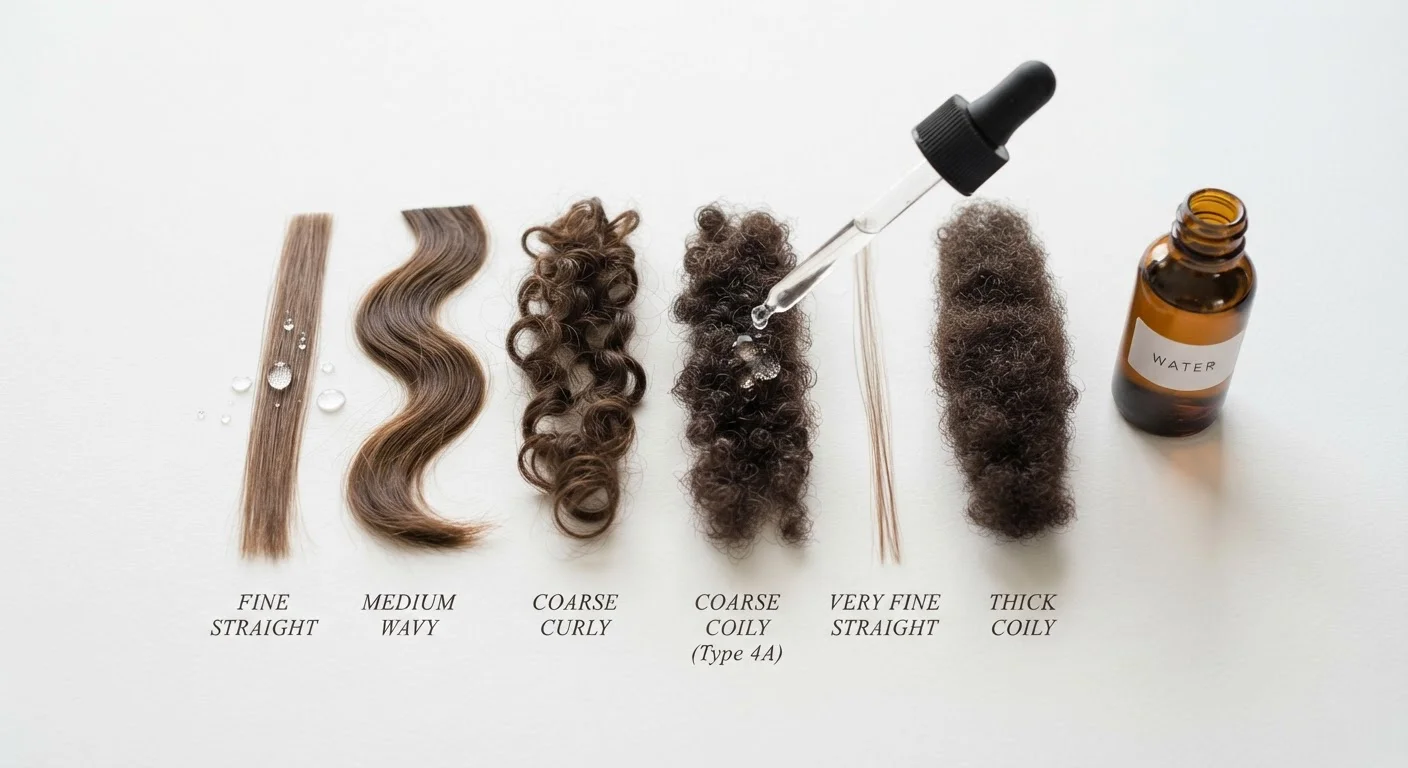
- Low porosity: Cuticles lie flat and tightly packed, making it harder for moisture and products to penetrate initially. Water beads on the surface. Heat — like a warm towel or steam — helps open the cuticle temporarily to allow better absorption. Lightweight, water-based products generally work better than heavy butters, which can sit on top of the strand and cause buildup.
- Medium (normal) porosity: Cuticles are slightly raised, allowing moisture in and holding it reasonably well. This is often the most manageable state, and a wide range of products work effectively.
- High porosity: Cuticles are raised or have gaps — often from chemical processing, heat damage, or genetics — meaning hair absorbs moisture quickly but loses it just as fast. Sealing with oils or butters after moisturizing helps slow moisture loss. Hair that feels dry again within days of washing is frequently a porosity issue, not simply a product deficiency.
3 Types
Porosity levels used in haircare assessment
Low, medium, and high porosity are the standard categories used by trichologists and haircare educators to guide product and technique recommendations.
~80,000–120,000
Average number of strands on a human head
This range, cited in dermatology literature, illustrates why density variation — even within that range — meaningfully changes how hair looks and how much product it requires.
Fine to Coarse
Strand diameter spectrum affecting treatment tolerance
Fine strands measure roughly 50 microns in diameter; coarse strands can exceed 80 microns — a difference that significantly affects how hair responds to protein and heavy conditioning agents.
Density: How Much Hair You Actually Have
Density measures the number of individual strands growing from your scalp per square inch — not the thickness of each strand. It's commonly categorized as low, medium, or high. A straightforward way to gauge yours: look at your scalp when your hair is down and dry. If scalp is easily visible without parting, density is likely low. If you can barely see scalp at all, it's probably high.
Density shapes product quantity more than product type. High-density hair requires more product to achieve even coverage and may need sectioning during application to ensure nothing gets missed. Low-density hair is easily weighed down — even a moderately heavy conditioner can flatten volume and make strands cling together. For this reason, volumizing or lightweight formulas are often preferred for lower-density hair.
Density also intersects with scalp health. Scalp care fundamentals become especially relevant when high-density hair traps product residue close to the skin, potentially affecting follicle health over time.
Texture: The Diameter of a Single Strand
Hair texture — sometimes called strand thickness — describes the width of an individual hair strand. The three general categories are fine, medium, and coarse. A simple test: hold a single strand between your fingers. If you can barely feel it, it's likely fine. If it feels substantial or even slightly wiry, it's probably coarse.
Texture matters enormously when selecting strengthening treatments. Coarse hair has a larger diameter and more cortex layers, meaning it typically tolerates and benefits from protein treatments well. Fine hair, by contrast, can become brittle and rigid with too much protein — a phenomenon sometimes called protein overload. Understanding texture helps you avoid over-treating your hair in an attempt to strengthen it.
Texture also affects how quickly hair dries, how it holds styles, and how it responds to humidity. Fine hair tends to absorb products more readily and can look limp with heavy formulations. Coarse hair may need richer products to smooth the cuticle and improve manageability. When you understand your texture, reading ingredient labels becomes a more focused exercise — you know what categories of ingredients to prioritize.
Assess Before You Shop
Before purchasing a new product, identify your porosity, density, and texture first. Then look at the product's consistency and main ingredient categories — rather than marketing language — and ask whether they match what your hair actually needs. A lightweight mist may be exactly right for low-porosity, high-density hair; the same product will do little for coarse, high-porosity strands that need sealing. Taking five minutes to assess can prevent months of disappointing results.
Reading All Three Properties Together
These three properties rarely operate in isolation. Consider two examples: someone with fine strands, high density, and low porosity will need a different approach than someone with coarse strands, low density, and high porosity — even if both have curly hair.
The first person needs enough product to cover many strands without weighing them down, and should focus on heat-assisted application to get moisture inside resistant cuticles. The second needs rich, sealing products used in smaller amounts so the few strands they have aren't flattened — and they need to prioritize moisture retention, not just moisture input.
Once you have this framework, building a consistent routine becomes far more logical. A structured wash-day routine built around your actual properties — rather than someone else's — is more likely to produce the consistent results that make a habit worth keeping.
“Hair responds to what it structurally is — not what we wish it were. Working with the hair's actual properties, rather than against them, is what separates a routine that lasts from one that constantly needs fixing.”
— Beauty Essentials Editorial Team, Haircare Research and Education