Why the Ingredients Panel Exists — and What It's Actually Telling You
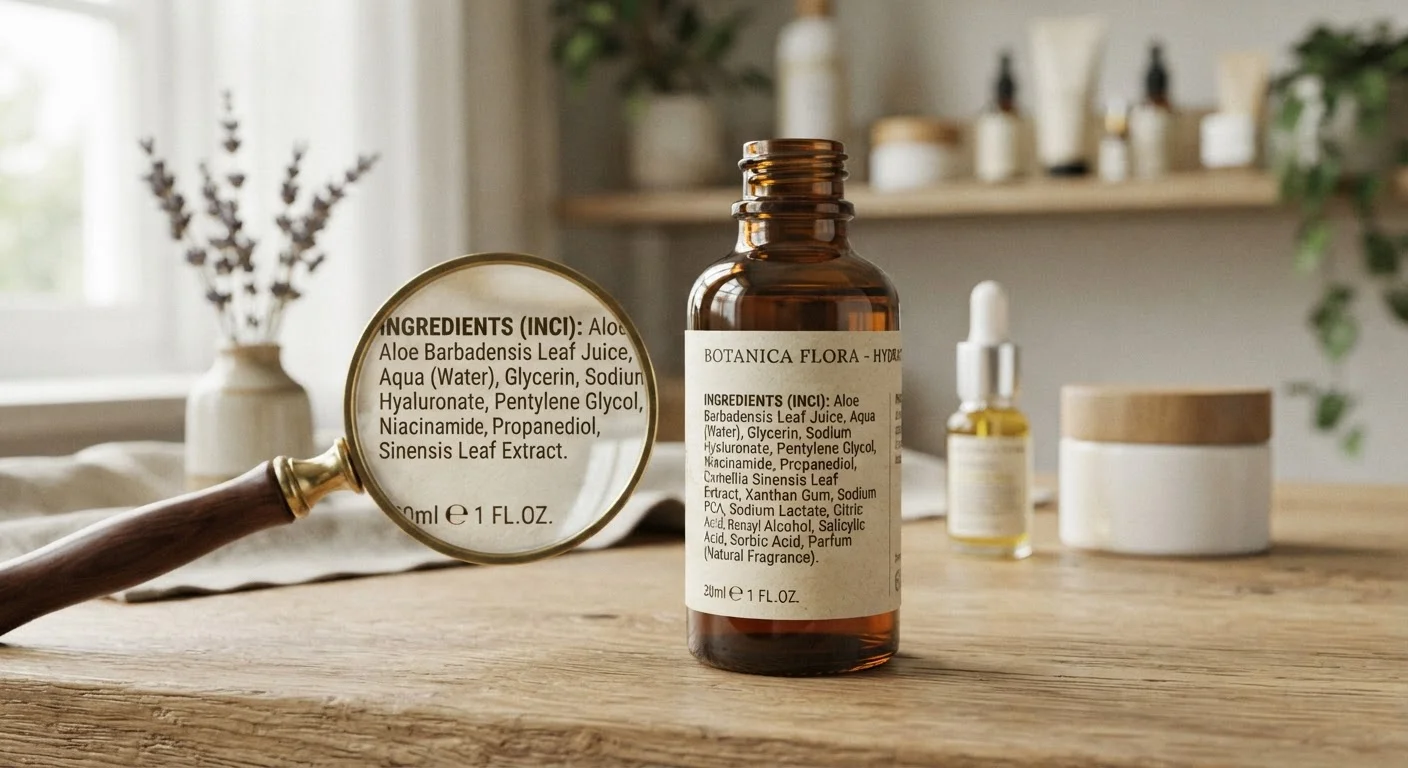
Every skincare product sold in the United States is required by the FDA to list its ingredients in a specific, standardized format. That list — known formally as the INCI list (International Nomenclature of Cosmetic Ingredients) — is printed in descending order by concentration. The ingredient present in the greatest amount appears first; the one present in the smallest amount appears last.
This ordering rule is the single most useful piece of information a label gives you. When a moisturizer lists aqua (water) first and a popular active ingredient tenth or lower, that tells you the product contains far more water than it does that active. Understanding this hierarchy prevents a lot of misplaced expectation.
A few consistent conventions are worth knowing. Ingredients present at 1% or below can be listed in any order after the ingredients above 1% — so the second half of most INCI lists is not a reliable guide to relative amounts. Fragrance compounds and colorants also have their own placement rules. Knowing this prevents over-interpreting the back of a bottle.
| Listing Standard | INCI (International Nomenclature of Cosmetic Ingredients) (U.S. FDA cosmetic labeling regulations) |
| Ordering Rule | Descending order by concentration (21 CFR Part 701.3) |
| 1% Threshold Exception | Ingredients at ≤1% may appear in any order after higher-concentration ingredients (FDA cosmetic labeling guidance) |
| Water Listing | Often labeled "Aqua" per INCI convention |
| Fragrance Disclosure | Listed as "Fragrance" or "Parfum" — individual compounds not required to be itemized (FDA cosmetic labeling rules) |
| Preservative Purpose | Ensures microbiological safety; typically appears near end of list |
Key Ingredient Categories to Recognize at a Glance
Most skincare ingredients fall into a handful of functional categories. Recognizing these categories — rather than memorizing every chemical name — is the practical skill worth building.
- Humectants draw moisture from the air or deeper skin layers toward the surface. Glycerin, hyaluronic acid, and panthenol are common examples. When you see these near the top of a list, the product is designed with hydration as a priority.
- Emollients and occlusives soften skin and slow water loss. Dimethicone, squalane, shea butter, and cetyl alcohol all serve this role. They appear most often in creams and ointments.
- Functional actives are ingredients included because they produce a specific skin-related effect — examples include retinol, niacinamide, salicylic acid, and ascorbic acid (vitamin C). These can appear anywhere on the list; concentration and formulation context matter more than position.
- Preservatives keep a product microbiologically safe. Phenoxyethanol, ethylhexylglycerin, and sodium benzoate are widely used. Their presence near the end of the list is normal and expected.
- pH adjusters and chelating agents — such as citric acid or EDTA — stabilize the formula and rarely have a direct effect on skin.
For a comparison of how these categories translate to haircare products, see ingredient label terms in haircare.
INCI
International Nomenclature of Cosmetic Ingredients — a standardized naming system used on cosmetic labels worldwide. It ensures that ingredient names are consistent regardless of the product's country of origin.
Humectant
An ingredient that attracts and retains moisture. Humectants pull water toward the skin's surface, helping to maintain hydration. Common examples include glycerin and hyaluronic acid.
Occlusive
An ingredient that forms a barrier on the skin's surface to prevent water from evaporating. Occlusives are common in thick creams and ointments; petroleum jelly and dimethicone are typical examples.
Emollient
An ingredient that softens and smooths the skin by filling in spaces between skin cells. Emollients improve texture and reduce rough or flaky appearance.
Active Ingredient
In cosmetics, an ingredient included specifically to produce a targeted skin effect — such as niacinamide for uneven tone or retinol for surface renewal. Concentration and formulation stability matter as much as presence.
Preservative
A substance added to a cosmetic formula to prevent microbial growth and extend shelf life. Preservatives are essential for safety and appear in virtually all water-containing products.
pH Adjuster
An ingredient used to calibrate the acidity or alkalinity of a formula. Maintaining the correct pH is critical for both product stability and compatibility with skin's natural acid mantle.
Chelating Agent
An ingredient that binds to metal ions in water to prevent them from destabilizing a formula. EDTA (disodium EDTA) is a widely used example.
Putting It Together: Smarter Label Reading in Practice
Once you understand the structure of an INCI list, a few practical habits follow naturally.
Look at the first five ingredients first. They typically make up the majority of the formula by weight. If the first five are mostly water, silicones, or waxes, the product is primarily a delivery base — not a concentrated active treatment.
Find your target active and note its position. A 2% concentration of niacinamide can be effective; 0.1% is likely cosmetic window dressing. Position isn't a perfect proxy for concentration, but an active listed among the last five ingredients of a long list is probably present in a small amount.
Watch for repeated ingredient forms. Formulators sometimes list multiple forms of the same ingredient class — for instance, several different silicones — which can make a formula appear richer in a particular category than a single listing would suggest.
Label reading pairs well with knowing how products work together. See the logic behind layering skincare products for guidance on sequencing what you buy. And if you're building a routine from scratch, building a morning skincare routine from the ground up offers a practical starting point.
"Fragrance" Covers a Lot of Ground
Under current U.S. regulations, manufacturers can list dozens of individual fragrance compounds under the single term "Fragrance" or "Parfum" without itemizing each one. If you have known sensitivities or are trying to avoid specific scent chemicals, this is a meaningful limitation of the INCI label as it appears on most products. Some brands voluntarily disclose full fragrance breakdowns on their websites.
This article is for general informational purposes only and is not a substitute for advice from a qualified dermatologist or healthcare provider. If you have a skin condition or specific concerns, consult a licensed professional before making changes to your skincare routine.