
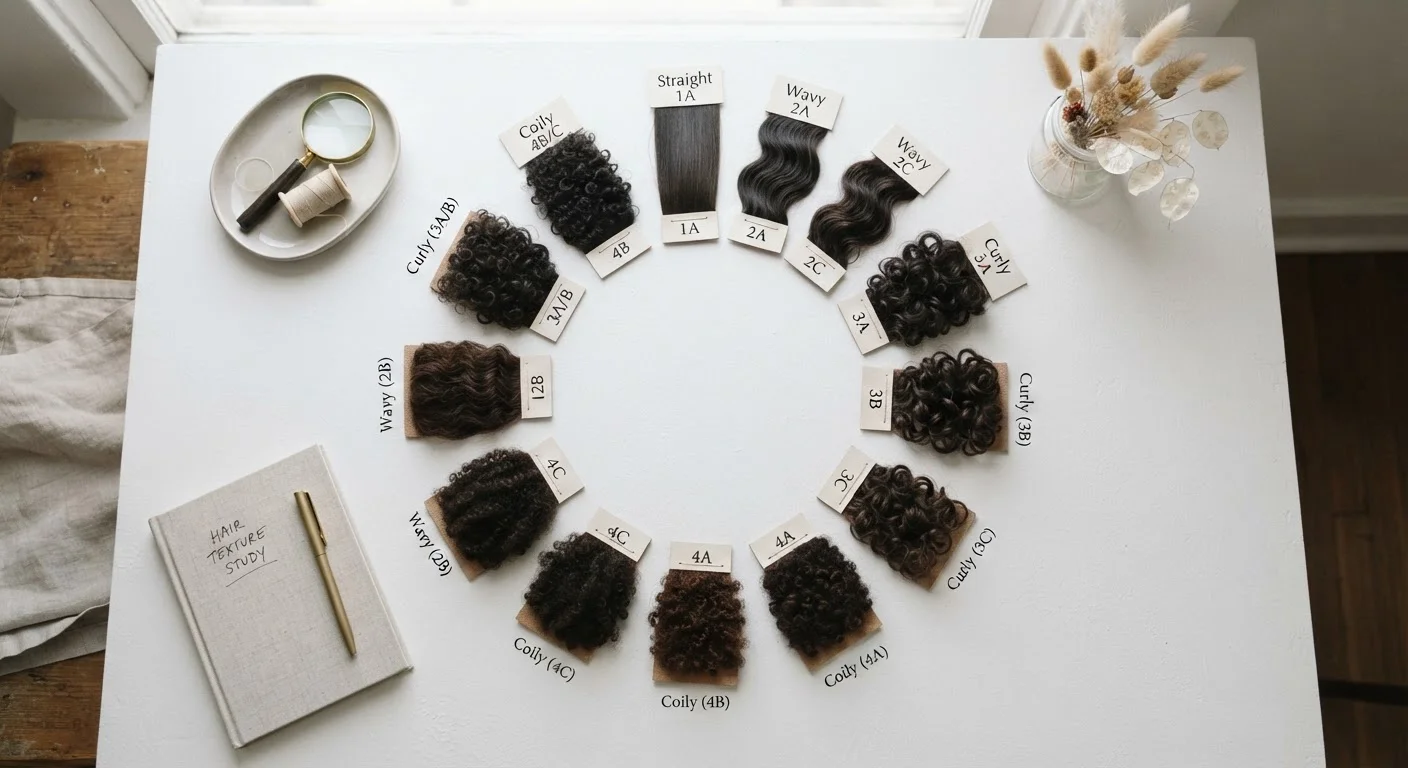
What Hair Typing Systems Actually Measure
Hair typing charts give curl pattern a number and a letter — and that's genuinely useful for one thing: describing what your hair looks like. When someone says their hair is 2A versus 4B, you get an immediate visual shorthand. That clarity has made these systems popular in online communities and on product packaging alike.
But curl pattern is a single physical characteristic. It doesn't describe porosity (how readily hair absorbs and retains moisture), density (how many strands grow per square inch), strand thickness, or elasticity. These properties collectively determine how your hair behaves with products, how it responds to humidity, and how much manipulation it can handle before breaking. Curl shape alone can't predict any of that.
Myth
My hair type number tells me exactly which products I should use.
Fact
Curl pattern describes the shape of your hair strand, not how it behaves with moisture, weight, or product ingredients.
The most widely used hair typing charts — which run from Type 1 (straight) through Type 4 (tightly coiled), with lettered subcategories — were designed as a visual classification tool. They answer one question: what shape does your curl or wave take? They say nothing about how quickly your hair absorbs water, how much product it can hold before weighing down, or how resistant your strands are to breakage.
Two people both labeled 3B can have completely different porosity levels, strand diameters, and scalp conditions — meaning a product that transforms one person's curls may leave the other's frizzy and limp. For deeper guidance on the properties that actually drive product performance, see our guide to porosity, density, and texture.
Myth
If a product is formulated for my hair type, it will work for me.
Fact
"For your hair type" on a label refers almost exclusively to curl pattern — which is only one variable in how your hair responds to a formula.
Marketing language on haircare packaging tends to map to the popular typing system because it's recognizable to consumers. But a shampoo marketed to 4C hair doesn't account for whether your hair is high or low porosity, fine or coarse in strand thickness, or prone to scalp dryness versus excess oil. Those factors often matter more to real-world results than curl shape.
Understanding what ingredients actually do — rather than which type they're marketed toward — is a more reliable shopping strategy. Our ingredient label glossary breaks down the categories you'll encounter most often.
Myth
Straight hair (Type 1) doesn't need much care because it's the least fragile.
Fact
Strand fragility depends on damage history, chemical processing, and porosity — not on whether hair is straight or curly.
Straight hair can be highly porous from heat damage, chemically weakened from coloring, and prone to breakage just like any other hair type. The assumption that straight hair is inherently low-maintenance can lead people to skip protective steps — like reducing heat tool temperatures or using a heat protectant — that their hair genuinely needs. For a balanced look at what repeated heat styling does to any hair type, see our overview of heat styling trade-offs.
Myth
Hair typing systems account for scalp health.
Fact
Hair typing charts describe the hair shaft only — scalp condition is an entirely separate consideration.
A curl pattern classification tells you nothing about whether your scalp produces excess sebum, tends toward dryness, or is prone to buildup. Yet scalp health directly affects the condition of the hair that grows from it. Neglecting the scalp while focusing only on curl-type-matched products is a common gap in many routines. Our scalp health primer covers the fundamentals regardless of hair type.
Myth
Everyone with the same letter subcategory (e.g., 3C) has the same hair needs.
Fact
Subcategories describe a range of curl shapes, not a uniform hair profile — individual variation within each category is significant.
Even within a single subcategory, strand thickness, density (how many hairs per square inch of scalp), and porosity create dramatically different real-world behavior. Dense, coarse 3C hair and fine, low-density 3C hair require different approaches to moisture, protein balance, and styling hold. Treating a letter subcategory as a precise prescription ignores this variation entirely.
Just as skin care benefits from distinguishing between skin type and skin condition — a distinction explored in our skin type vs. skin condition article — haircare benefits from separating curl pattern from the broader set of properties that shape your routine.
Building a Routine Beyond the Number
Once you understand what hair typing doesn't cover, the practical question becomes: what should you use instead? The answer isn't to abandon hair typing — it's to layer additional properties on top of it. Porosity, density, and strand texture are the variables that most directly inform whether a product will absorb or sit on the surface, weigh hair down or provide enough hold, and whether a formula needs more humectants or more sealants.
Typing Charts Are a Tool, Not a Rulebook
Hair typing systems were developed to describe curl shape — not to dictate product choices or routine steps. Applying a curl-type number too rigidly can lead you toward products that don't actually serve your hair's real needs. Use your hair type as one data point among several, not as the final word on what works for you.
Scalp condition adds another layer entirely. Whether your scalp tends toward dryness, oiliness, or sensitivity affects which cleansing frequency and shampoo formulation will serve you — and no curl pattern chart addresses that. Similarly, if your hair has been chemically processed or heat-styled regularly, its porosity and structural integrity may have shifted, making its current behavior quite different from what a typing chart would suggest for your curl shape alone.
Thinking through these dimensions together — curl pattern, porosity, density, texture, and scalp health — gives you a far more accurate foundation for product selection than any single classification system can provide on its own.