Why a Nail Care Routine Matters
Nails are more than an aesthetic detail. Healthy nails signal good hygiene, protect sensitive fingertips, and — because they grow slowly and show cumulative damage — they reward consistent care far more than occasional attention. If your nails chip, peel, or feel dry no matter what polish you choose, the gap is usually routine, not product.
A nail care routine does not need to be elaborate. The fundamentals — cleaning, shaping, moisturizing, and protecting — take fewer than ten minutes a week once they become habitual. If you already follow a skincare routine in the morning, adding nail care is a natural extension. The same logic applies: steady, simple habits outperform sporadic intensive treatments. For a parallel starting point with skincare, see our morning skincare routine guide.
The Tools You Actually Need
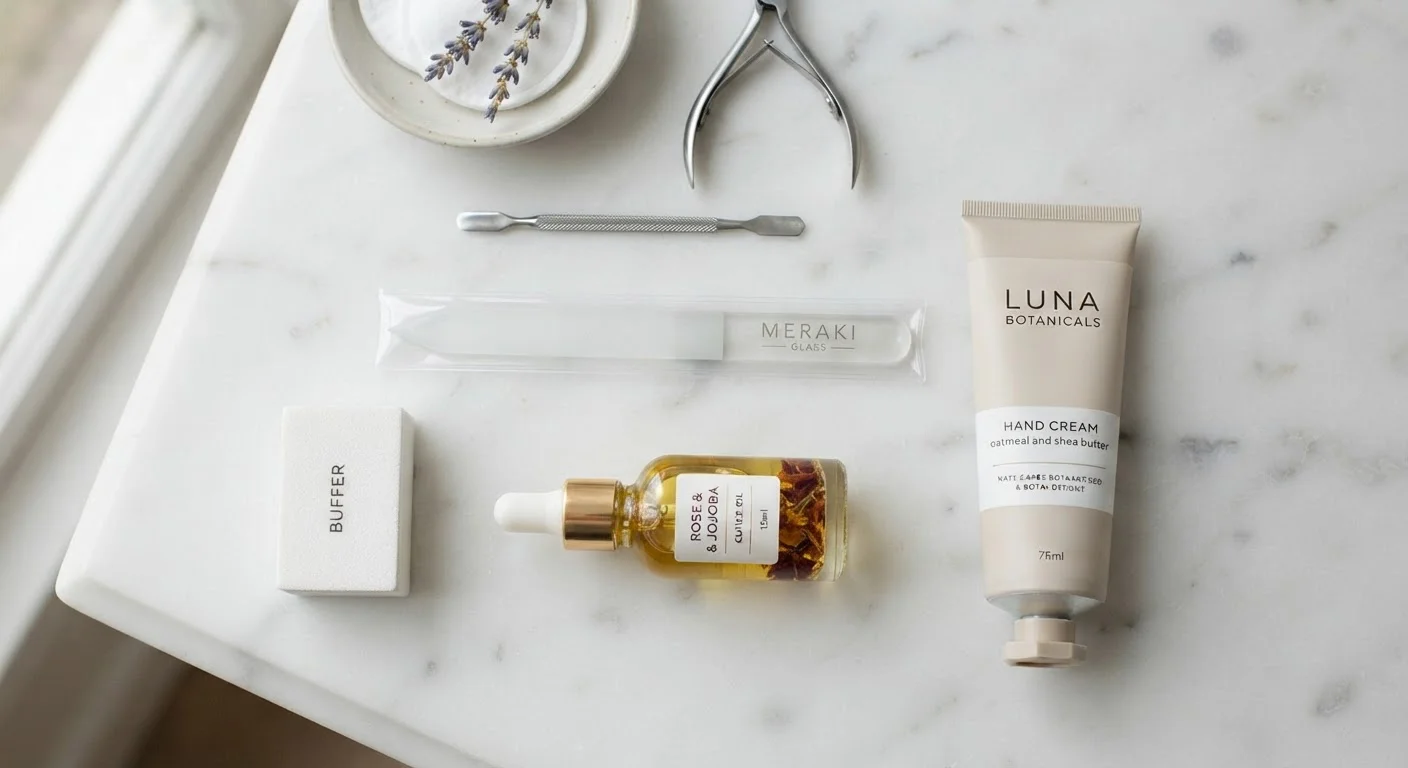
The nail care aisle can feel overwhelming, but beginners need only a small core set of tools to get started. Buying too much upfront often means most of it goes unused.
Free edge
The part of the nail that extends beyond the fingertip — the section you trim and file.
Nail matrix
The tissue beneath the base of the nail where new nail cells are produced. Damage here can affect how the nail grows.
Cuticle
The thin layer of skin that overlaps the base of the nail plate. It acts as a seal protecting the nail matrix from bacteria.
Nail plate
The hard, visible part of the nail — what most people simply call 'the nail.'
Buffer block
A multi-sided foam block used to smooth ridges and add shine to the nail surface without polish.
Base coat
A clear or lightly tinted polish applied before color polish to prevent staining and help the color adhere longer.
- Nail file or emery board — for shaping and smoothing the free edge
- Buffer block — for smoothing ridges on the nail surface
- Cuticle pusher — a rubber-tipped or wooden tool to gently move back cuticle skin
- Nail clippers — for trimming length before filing
- Cuticle nipper (optional) — only for removing loose, dead skin, not healthy cuticle
For a plain-language breakdown of what each tool does and how to keep it clean, see our nail tool glossary. Keeping tools clean between uses — with isopropyl alcohol or washing metal tools with soap — reduces the chance of transferring bacteria to the nail fold.
The Core Steps of a Basic Routine
Follow this sequence roughly once a week. It works best done after a shower or a brief soak, when nails are slightly softened.
- Remove old polish — use an acetone-free remover if your nails tend to dry out easily.
- Trim length if needed — clip straight across, then round or square corners to your preferred shape.
- File and shape — move the file in one direction from corner to center on each side. Avoid the back-and-forth sawing motion, which frays the nail edge.
- Buff lightly — one or two passes across the surface smooths visible ridges. Do not over-buff; thinning the nail plate weakens it.
- Clean under the free edge — a clean brush or the pointed end of a wooden cuticle stick works well.
- Apply base coat if using polish — this protects the nail from staining and improves polish longevity.
Apply Cuticle Oil Before Bed
Nighttime is an ideal window for cuticle oil because your hands are at rest and not being washed repeatedly. A few drops massaged into the base of each nail while winding down for bed can make a real difference in softness and flexibility over time. Keep a small bottle on your nightstand to build the habit naturally.
Weather affects nail flexibility more than most people expect. Cold, dry winters tend to make nails brittle, while humid summers can temporarily soften them. Our article on keeping nails strong through seasonal changes covers practical adjustments for each season.
Moisturizing and Cuticle Care
This is where most beginner routines fall short. Filing and shaping are visible steps; moisturizing feels invisible — until you skip it long enough to notice peeling, hangnails, or dry, tight cuticle skin.
Cuticle oil is the single highest-impact daily habit for nail health. Applied to the base of each nail once a day — or even a few times a week — it keeps the cuticle skin pliable and reduces tearing. Look for oils containing ingredients such as jojoba, vitamin E, or sweet almond oil, which are commonly found in cuticle formulas and help the product absorb easily.
Hand cream or lotion applied after washing your hands helps prevent the moisture loss that makes nails and surrounding skin brittle. Nails themselves do not absorb cream well, but keeping the skin around them hydrated supports overall nail health.
Avoid Cutting Healthy Cuticle Tissue
Cutting into healthy cuticle skin — rather than just loose or overgrown pieces — removes a protective barrier and can lead to irritation, bleeding, or infection. If the area becomes red, swollen, or painful after trimming, stop and allow it to heal. Persistent nail fold symptoms should be evaluated by a healthcare professional.
On cuticle cutting: dermatologists generally advise against cutting healthy cuticle tissue. The cuticle seals the nail matrix — the growth center at the nail base — from bacteria and debris. Cutting into it can cause irritation, infection, or inflammation. If you prefer a neater look, softening and gently pushing back cuticles with a tool is the lower-risk approach.
If you notice persistent redness, swelling, or pain around the nail fold, that warrants a visit to a healthcare professional rather than a DIY fix.
Building Consistency Without Overwhelm
The most common reason nail care routines fail is scope creep — adding too many steps too soon and then abandoning the whole thing. Start with just three habits: a once-weekly shape and file, daily cuticle oil, and hand cream after washing. That is it for the first month.
Once those feel automatic, you can layer in a base coat, experiment with polish finishes, or explore the difference between gel and traditional options. Our overview of gel vs. regular polish trade-offs is a useful next read when you reach that point.
Nail care fits naturally alongside other grooming habits. If you already have a skincare or haircare routine, attaching a quick cuticle oil step to that same moment in your day reduces the friction of building a new habit. For inspiration on how routine-building works across beauty categories, our skincare basics hub offers a useful parallel framework.
This article is for general informational purposes only and is not a substitute for professional medical or dermatological advice. If you have concerns about nail health, skin conditions, or symptoms around the nail area, consult a qualified healthcare professional.