Why Foundation Finish Matters
When shoppers compare foundation options, they often focus on shade and coverage — but finish can be just as important for how the final look reads in real life. Two foundations with identical coverage levels can look completely different on the same person simply because one is matte and the other is dewy.
Finish also affects wearability. The wrong finish for your skin type can make oiliness more visible by midday, cause dry patches to look flaky, or make pores appear more prominent. Understanding what each finish actually does helps you narrow choices before you ever try a swatch.
If you're still mapping your skin type — whether it's genuinely oily or going through a dry spell — it's worth reading about skin type vs. skin condition before locking in a foundation finish. Knowing the difference can meaningfully change what you reach for.
~60%
Foundation buyers who cite finish as a key decision factor
Industry consumer research consistently identifies finish and coverage as the top two decision drivers when shoppers evaluate foundation options.
3 main types
Foundation finishes recognized across cosmetic industry labeling
Matte, satin/natural, and dewy/luminous are the three broad finish categories used by most cosmetics brands to describe their foundation formulas.
Matte Finish: Flat, Shine-Free, and Controlled
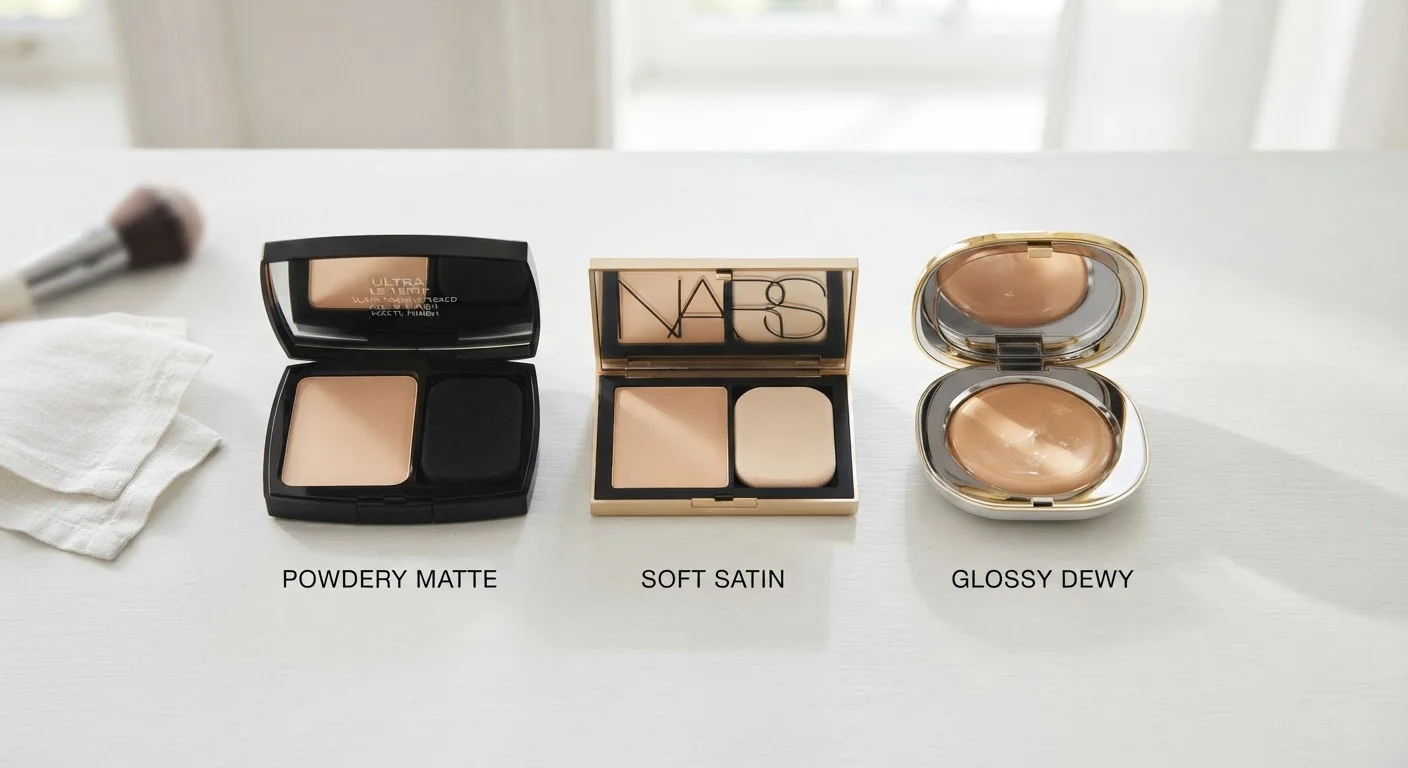
A matte foundation absorbs rather than reflects light, producing a smooth, uniform surface with no visible sheen. On the skin, this reads as polished and controlled — often described as a "filtered" effect that minimises the appearance of pores and excess oil.
Matte formulas typically contain oil-absorbing ingredients like silica or kaolin clay. They tend to perform well in humid or warm conditions and are a common choice for photography and stage work where shine can be distracting under bright lighting.
The tradeoff: matte foundations can settle into fine lines or dry patches if the skin beneath isn't well-hydrated. Applying a hydrating primer first reduces this risk. If a matte formula feels too flat, a targeted highlighter on the high points of the face reintroduces dimension without sacrificing the shine control elsewhere.
Prep Skin Before Applying Matte Foundation
Matte formulas adhere most smoothly to well-moisturised skin. Even if your skin is oily overall, applying a lightweight, non-comedogenic moisturiser before a matte foundation helps prevent dry patches from becoming visible through the finish. Allow the moisturiser to absorb fully — about 60 seconds — before applying foundation.
Satin Finish: The Versatile Middle Ground
Satin — sometimes labeled natural or soft-matte — sits between matte and dewy. It reflects a modest amount of light, mimicking the quiet luminosity of clean, moisturised skin. Neither flat nor obviously glowing, it's widely considered the most adaptable finish across skin types and settings.
Because it doesn't exaggerate shine or completely suppress it, a satin foundation tends to look realistic in a range of lighting conditions — daytime natural light, office fluorescents, or evening restaurant lighting. For people building a foundational makeup kit, a satin-finish formula is often the most practical starting point. For more guidance on building that kit, see a makeup starter kit guide.
On combination skin — oily in some zones, normal or dry in others — satin often performs better than either extreme, reducing the likelihood of a jarring contrast between areas.
Dewy Finish: Luminous, Fresh, and Skin-Like
Dewy foundations are formulated to produce visible light reflection across the face, creating what's often described as a fresh, glass-skin effect. They typically contain emollients, humectants like glycerin, or light-scattering mica particles that keep the skin looking plump and radiant.
This finish tends to be most flattering on dry, normal, or mature skin, where it compensates for reduced natural oil production and prevents the complexion from looking dull or flat. It's also associated with a more current, natural-looking aesthetic in everyday makeup.
On oily or acne-prone skin, dewy formulas can intensify shine and may not hold as long without a mattifying setting powder over oil-prone areas. If luminosity is the goal but full dewy is too much, look for formulas described as "radiant" or "glow" — these often offer a more restrained version of the effect.
Pairing any foundation finish with the right shade and undertone is equally important — see understanding your skin undertone for guidance on finding a flattering match.
Adjusting Finish With Primers and Setting Products
One of the most useful things to understand about foundation finish is that it isn't fixed at the formula level. Products applied before and after foundation can shift the finish meaningfully.
- Mattifying primer under a satin or dewy foundation moves the result toward a more controlled, less shiny finish.
- Hydrating or illuminating primer under a matte foundation softens its flatness and prevents dry-patch settling.
- Translucent setting powder reduces shine and nudges any finish toward matte — use sparingly on dewy formulas if you want to preserve some glow.
- Hydrating or dewy setting spray softens a matte finish post-application and adds a fresh, skin-like quality.
These adjustments mean a single foundation can perform differently depending on your routine. Experimentation helps — there's no formula that works identically on every person.
Finish Can Look Different Across Lighting Conditions
A foundation that appears satin in natural daylight may look slightly more matte under fluorescent office lighting and more dewy under warm evening light. This is worth considering when choosing a finish for a specific occasion. Testing a foundation in multiple lighting environments before committing gives a more accurate picture of how it will actually perform.