What Each Product Is Actually Doing
Concealer and color corrector are often lumped together, but they operate on completely different principles. Understanding that distinction is the fastest way to get more out of both.
Concealer is formulated to match your skin tone. It deposits pigment that mimics your complexion, making discoloration visually disappear by blending it into the surrounding skin. It works best when the discoloration isn't too far from your base skin color — think minor redness, small blemishes, or light shadowing.
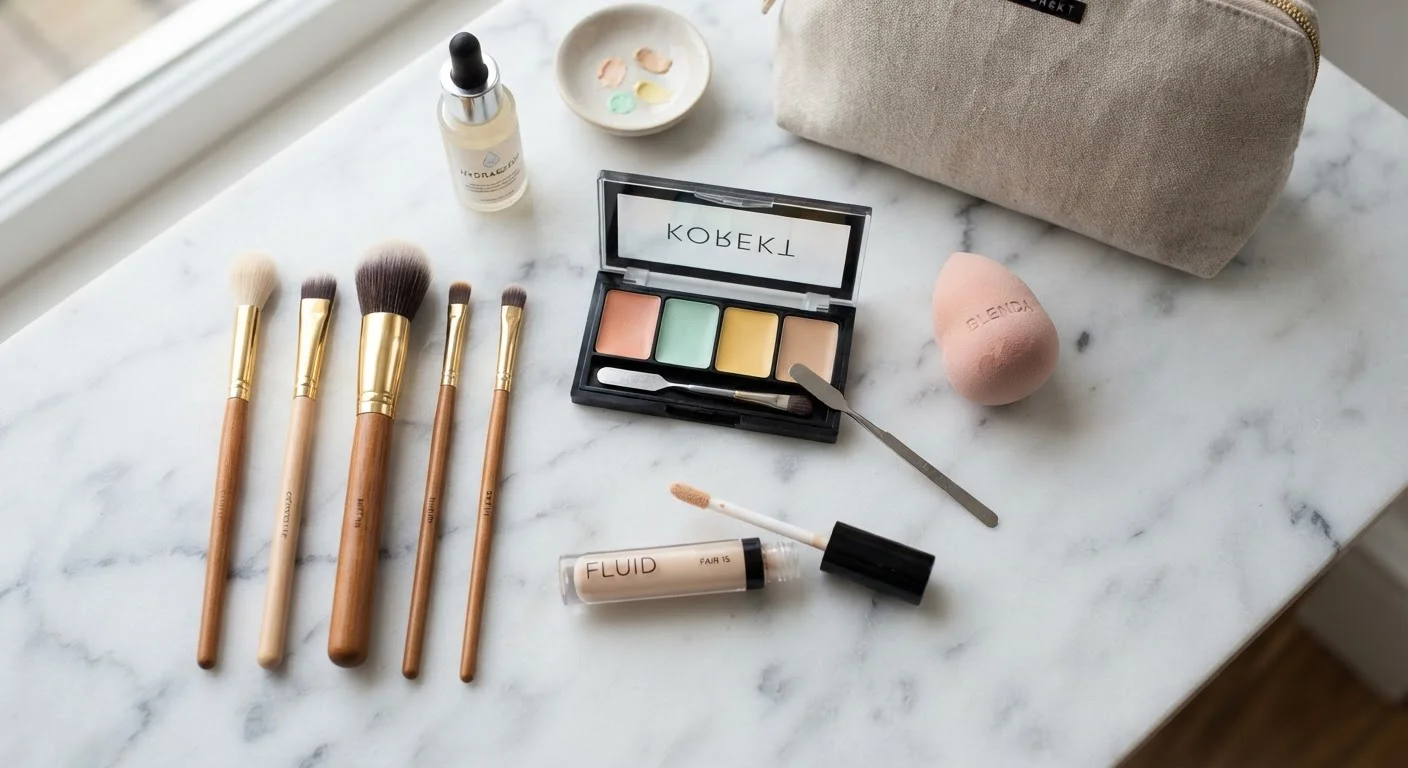
Color corrector, by contrast, relies on color theory. Every corrector shade targets a specific discoloration by using the opposite hue on the color wheel. Peach and orange correctors counteract blue and purple tones (the most common culprits in under-eye circles). Green correctors neutralize redness. Yellow cancels out violet or lavender-toned marks. The corrected area doesn't disappear after this step — it simply becomes neutral enough that a thin layer of concealer or foundation can now blend it away effortlessly.
If you've ever piled on concealer and still seen the original discoloration bleeding through, you've experienced what happens when you skip this neutralizing step.
| Criterion | Concealer | Color Corrector |
|---|---|---|
| Primary function | Matches and covers discoloration | Neutralizes discoloration with opposite hue |
| Color range | Skin-tone shades | Peach, orange, green, yellow, lavender |
| Application order | Applied after color corrector | Applied first, before concealer |
| Best for | Minor redness, blemishes, light shadows | Dark circles, hyperpigmentation, strong redness |
| Necessary for all routines? | Yes — versatile everyday staple | No — targeted, need-specific tool |
| Skill level required | Beginner-friendly | Moderate — shade selection takes practice |
How Skin Tone Affects Your Corrector Choice
Color correctors aren't one-size-fits-all, and the same discoloration can call for a different corrector shade depending on your skin's depth and undertone. This is where understanding your undertone becomes genuinely useful rather than abstract.
For fair to light skin tones, lavender or pink correctors work well for yellow or sallow patches, while a light peach addresses under-eye darkness. For medium to tan skin tones, a deeper peach or soft orange tends to neutralize shadows more effectively than a lighter peach would. For deep to rich skin tones, true orange or red correctors typically provide the contrast needed to counteract dark circles and hyperpigmentation.
Green corrector for redness works across most skin tones, though on deeper skin, a yellow or bisque shade may blend more naturally. The goal in every case is to apply the corrector as thinly as possible — just enough to shift the discoloration toward neutral before concealer goes on top.
A Note on Corrector Shade Matching
Many color correctors appear quite vivid in the pan, which can make them seem intimidating to apply. In practice, a thin application blends down significantly and should not be visible under concealer or foundation. If the corrected area looks obviously tinted after blending, the corrector layer is likely too thick — not the wrong shade. Sheering it out with a damp sponge before applying concealer usually resolves the issue.
Application Order and Technique
If you're using both products, sequence matters. Color corrector always goes on first, directly on the area of concern. Use a small brush or the pad of a ring finger and apply in a patting — never rubbing — motion to avoid disturbing skin texture. Allow it to set for a moment before moving on.
Concealer follows, applied on top of the corrected area and blended outward. Because the discoloration is already neutralized, you should need far less concealer than you would if applying it directly to uncorrected skin. Set both layers with a light dusting of translucent or setting powder to prevent creasing and improve wear.
One common misstep is using too much of either product. Thick layers interact poorly with each other and with foundation, leading to that telltale cakey finish under the eyes or around the nose. Thin, buildable application — adding a touch more only where necessary — consistently delivers a more natural result.
For a broader look at how these products fit into an everyday routine, see our guide to building a starter makeup kit that covers the essentials without the overwhelm.
2-step
Corrector-then-concealer sequence for best results
Professional makeup artists widely recommend applying corrector before concealer to neutralize discoloration before adding skin-tone pigment on top.
Color wheel
The principle behind every corrector shade
Color correctors work by placing complementary (opposite) hues against each other — a foundational concept in color theory applied directly to makeup formulation.
Do You Actually Need Both?
Honestly, not always. Color correctors are targeted tools, and if your primary concern is mild, everyday redness or an occasional blemish, a well-matched concealer is genuinely sufficient. Adding a corrector to a routine that doesn't need one can complicate blending and increase the chance of visible product buildup.
Color correctors earn their place when discoloration is deep, persistent, or strongly pigmented — the kinds of concerns that consistently resist concealer alone. Dark under-eye circles with a distinctly blue or purple cast, significant post-inflammatory hyperpigmentation, or stubborn facial redness are the scenarios where a corrector shifts from optional to genuinely useful.
It's also worth noting that some common makeup assumptions can lead people to over-product unnecessarily. More product doesn't always mean more coverage — technique and product selection typically matter more. If your concealer isn't performing as expected, it's worth asking whether the shade match is truly accurate or whether the formula suits your skin type before adding a corrector to the mix.