The Physics Nobody Thinks About
Most drivers significantly underestimate how long it takes to stop a moving vehicle. At 60 mph, a car travels roughly 88 feet every second. Factor in a typical human reaction time of 1.5 seconds — the time between seeing a hazard and actually depressing the brake pedal — and you've already covered 132 feet before braking even starts. Add braking distance on top of that, and a full stop from 60 mph can easily require more than 240 feet under ideal dry-road conditions.
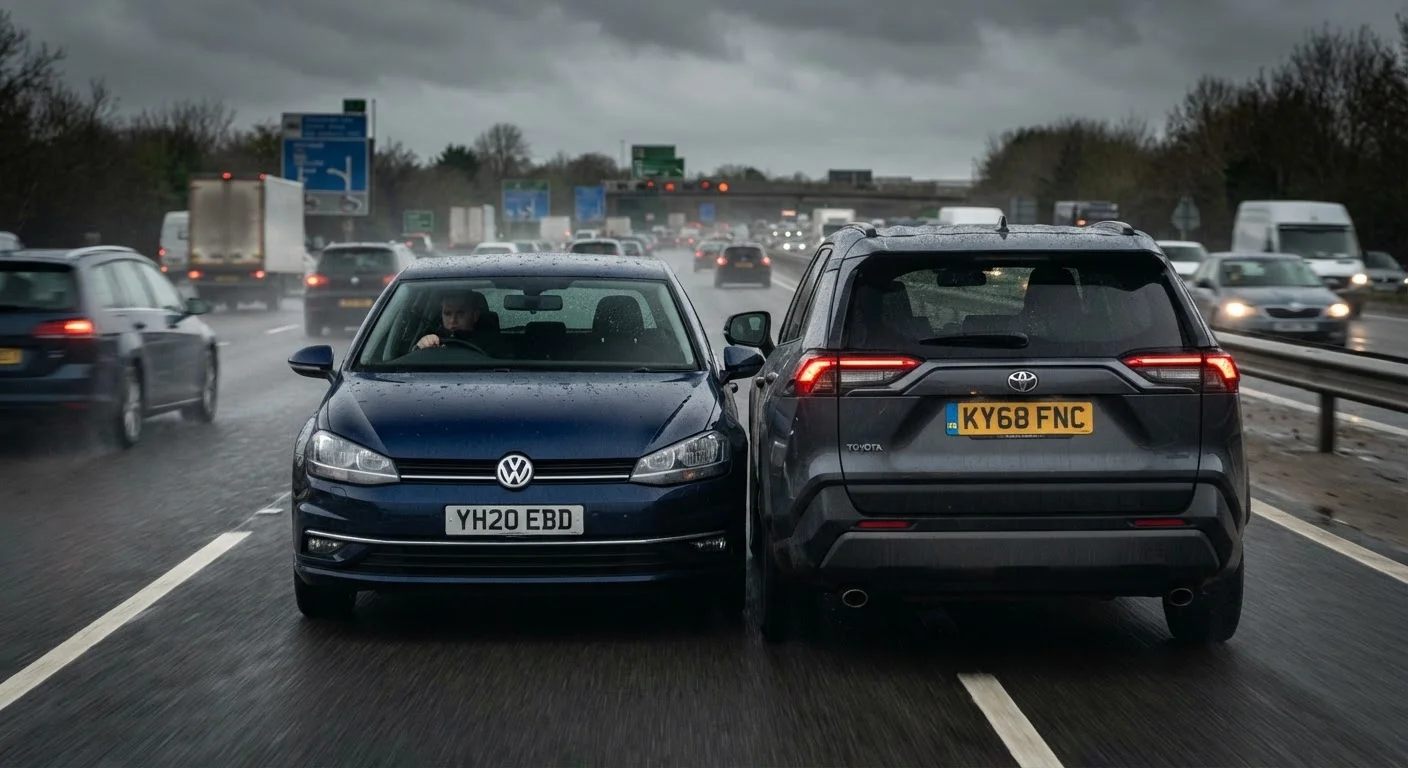
Now compress that gap to one or two car lengths — the cushion many tailgaters leave — and the math becomes unforgiving. There is simply no physical margin for error. When the vehicle ahead brakes hard for a debris strike, an animal, or a sudden traffic slowdown, a following driver has no realistic opportunity to avoid impact.
Conditions make this worse, not better. Wet pavement alone can extend stopping distances by 50% or more. See our guide to driving in rain, snow, and fog for a detailed look at how conditions compound stopping distance. Yet many drivers maintain the same following gap in a downpour as they would on a dry summer afternoon.
Common Tailgating Mistakes — and How to Correct Them
Understanding the specific errors drivers make — and why — is the first step toward changing ingrained habits.
Relying on car lengths instead of time-based following distance.
Why it happens: Most drivers think in visual terms — how many cars fit between them and the vehicle ahead. But vehicle length varies widely, and this method doesn't account for speed.
Maintaining highway-speed following distances in adverse conditions.
Why it happens: Drivers often fail to consciously recalibrate when roads are wet, icy, or visibility is reduced — habits developed in good conditions carry over automatically.
Closing the gap when a slower driver is ahead rather than changing lanes safely.
Why it happens: Frustration with slower traffic leads some drivers to use proximity as a form of pressure — unconsciously or deliberately tailgating to signal impatience.
Trusting automatic emergency braking to compensate for short following distances.
Why it happens: Drivers with newer vehicles sometimes assume AEB makes tailgating survivable, without understanding the system's speed thresholds and environmental limitations.
Failing to account for the vehicle's total stopping weight and load.
Why it happens: Drivers of trucks, SUVs, or vehicles towing trailers often apply the same following habits they used in lighter passenger cars, despite significantly longer stopping distances.
It's also worth confronting a persistent myth: that being a confident, experienced driver offsets the need for following distance. Research consistently shows that overconfidence is itself a risk factor. For a broader look at how common beliefs diverge from crash data, see common road safety myths drivers still believe.
What the Crash Data Actually Shows
~29%
Share of all U.S. crashes that are rear-end collisions
According to NHTSA crash data, rear-end crashes consistently represent close to one-third of all reported collisions on American roads.
132 ft
Distance traveled before braking begins at 60 mph
At 60 mph with a 1.5-second reaction time, a vehicle covers approximately 132 feet before the brakes are applied — before any actual slowing occurs.
50%+
Increase in stopping distance on wet pavement
Traffic safety research indicates that wet roads can extend stopping distances by 50% or more compared to dry conditions at the same speed.
Rear-end collisions are not minor fender-benders in aggregate. According to the National Highway Traffic Safety Administration (NHTSA), rear-end crashes represent one of the most frequent crash types on U.S. roads and are a leading cause of whiplash injuries, which can produce lasting musculoskeletal problems. At highway speeds, rear-end impacts become a serious injury and fatality risk — particularly for occupants in the struck vehicle, who have no opportunity to brace or react.
Distraction and tailgating frequently occur together. A driver following closely is also less likely to have peripheral attention available for scanning the broader traffic environment — creating compounded risk. Teen and new drivers are especially vulnerable to this combination; research on why new drivers crash more highlights how inexperience amplifies the consequences of reduced following distance.
Tailgating Is a Crash Cause, Not Just a Bad Habit
Following too closely is classified as a contributing factor in a substantial share of rear-end crashes — many of which result in injury. At highway speeds, these are not low-speed events. Drivers should understand that closing the gap to another vehicle doesn't just increase inconvenience: it systematically removes the time and space needed to avoid a collision.
Building a Safer Following Habit
The universally recommended starting point is the two-second rule: pick a fixed roadside marker, and after the vehicle ahead passes it, count two full seconds before you reach the same point. At higher speeds, or in poor visibility or road conditions, extend that gap to three or four seconds. This is not overly cautious driving — it is standard practice aligned with safe-driving curricula and traffic safety research.
Modern vehicles equipped with automatic emergency braking (AEB) provide a meaningful safety layer, but they are not a substitute for proper following distance. AEB systems have operational limits — they may not react quickly enough at high closure speeds, and some systems perform less reliably in rain, glare, or complex traffic environments. Understanding what your vehicle's safety systems can and cannot do is essential. How active and passive safety systems work together explains this distinction clearly.
Finally, be aware that fatigue degrades both reaction time and hazard perception — two factors already under pressure when following distance is short. If you're on a long drive, learn why driver fatigue is so commonly underestimated before dismissing tiredness as a minor inconvenience.
Don't Let Impatience Override Judgment
Tailgating to pressure a slower driver is both dangerous and ineffective. Studies on traffic flow suggest that aggressive following rarely produces meaningful travel time gains, while substantially raising crash risk. If you feel frustration building on the road, treating it as a cue to deliberately increase your following gap — not reduce it — is a practical, evidence-aligned response.