The Numbers Behind Teen Crash Risk
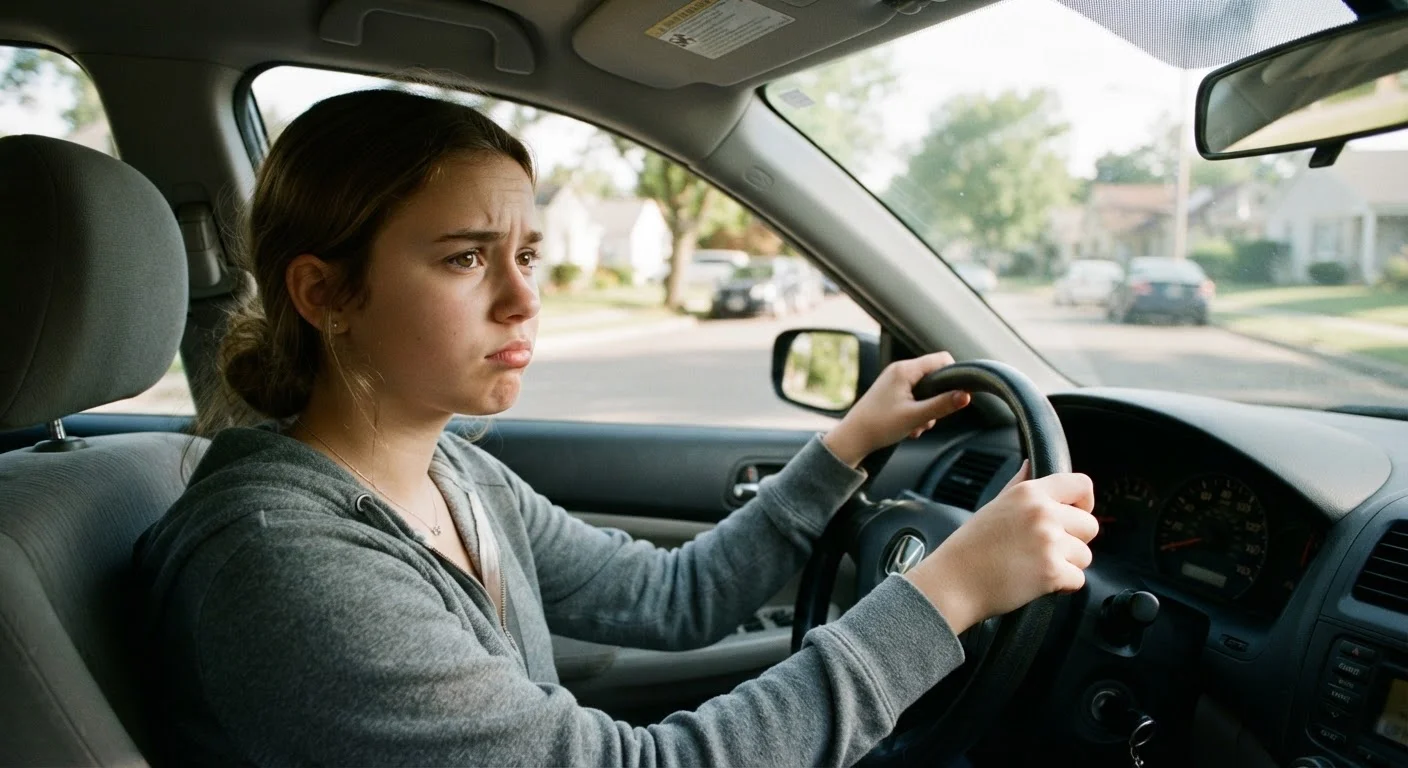
Motor vehicle crashes are the leading cause of death for teenagers in the United States, according to the Centers for Disease Control and Prevention. Drivers aged 16–19 are involved in crashes at a rate nearly three times higher than drivers aged 20 and older per mile driven — and the risk peaks during the very first months of solo driving.
The pattern is not random. Crash data from the National Highway Traffic Safety Administration (NHTSA) and the Insurance Institute for Highway Safety (IIHS) consistently points to a cluster of specific situations — nighttime driving, peer passengers, high speeds, and unfamiliar roads — as the conditions where inexperienced drivers are most likely to be involved in serious collisions.
~3x
Higher crash rate for teens vs. older drivers
Per mile driven, drivers aged 16–19 crash at roughly three times the rate of drivers aged 20 and older, according to NHTSA data.
40%
Teen driver fatalities occurring at night
Approximately 40% of teen driver deaths occur between 9 p.m. and 6 a.m., according to the Insurance Institute for Highway Safety.
2x
Crash risk increase with one teen passenger
AAA Foundation for Traffic Safety research indicates that carrying a single teen peer passenger approximately doubles crash risk for teen drivers.
Understanding why the numbers look this way requires looking beyond behavior and into the underlying factors that make new drivers genuinely different from experienced ones.
Brain Development and Driving: An Incomplete System
One of the most consequential — and least discussed — factors in teen crash risk is neuroscience. The prefrontal cortex, the region of the brain responsible for impulse control, risk assessment, and the ability to weigh consequences, is not fully developed until the mid-20s. Teenagers are not simply choosing to take risks; in many situations, their brains are structurally less equipped to recognize or resist them.
This is compounded by the reward sensitivity that characterizes adolescent brain chemistry. Research in developmental psychology suggests that teens experience a stronger dopamine response to novel, exciting, or socially reinforced experiences — including fast driving or impressing peers. That reward signal can override the weaker braking system of an underdeveloped prefrontal cortex.
“The teenage brain is not a defective adult brain — it is a brain optimized for a different set of priorities than the careful, long-range risk calculation that safe driving demands.”
— Sandra Aamodt, Neuroscientist and author of 'Welcome to Your Child's Brain'
These neurological realities do not excuse unsafe behavior, but they do explain why supervision, structured practice, and graduated licensing restrictions are more than bureaucratic formality — they are compensating for a genuinely incomplete cognitive system.
Hazard Perception: The Skill That Takes Years to Build
Experienced drivers don't just react faster — they see differently. A driver with 10 years of experience scans intersections, reads the body language of pedestrians, and anticipates the behavior of other vehicles largely automatically. This skill, called hazard perception, develops through thousands of hours of exposure to real driving situations.
New drivers lack this pattern library. When a situation unfolds quickly — a car edging out of a side street, a cyclist drifting into a lane, brake lights cascading suddenly on a highway — novice drivers both notice the hazard later and take longer to decide how to respond. That fraction-of-a-second delay can be the difference between a close call and a collision.
Studies using eye-tracking technology have shown that teen drivers spend more time looking at the center of the lane directly in front of them and less time scanning mirrors, intersections, and peripheral zones compared to experienced drivers. The gaze pattern itself reflects inexperience, independent of speed or phone use.
For more on how reaction time compounds following-distance risk, see our explainer on tailgating dangers.
High-Risk Scenarios: Where Crashes Actually Happen
Data consistently identifies the same categories of high-risk driving situations for teen drivers:
- Nighttime driving: About 40% of teen driver fatalities occur between 9 p.m. and 6 a.m., despite far fewer miles driven in those hours. Reduced visibility and fatigue multiply the hazard perception deficit.
- Peer passengers: The presence of teen passengers significantly raises crash risk — not because passengers are always distracting, but because the social dynamic shifts decision-making toward impression management and away from caution.
- Highways and high-speed roads: Speed compresses response time. On a 65 mph highway, a one-second delay in hazard recognition translates to nearly 100 feet of additional stopping distance.
- Adverse weather conditions: New drivers have little practice managing the vehicle dynamics that change in rain, snow, or fog. See our guide to driving in adverse weather for a breakdown of how conditions change vehicle behavior.
Structure Practice Around High-Risk Conditions
Rather than avoiding night driving or rain until a teen has their full license, supervised practice in these exact conditions — with an experienced adult — is one of the most effective ways to close the hazard perception gap before solo driving begins. Simulating difficulty gradually builds the cognitive patterns that protect new drivers when conditions aren't ideal.
These are not simply times when teens make poor choices — they are conditions that genuinely overwhelm cognitive systems still under construction.
What Reduces the Risk
The crash rate for teen drivers is elevated, but it is not fixed. Several evidence-backed factors consistently reduce novice driver crash risk:
Graduated Driver Licensing (GDL): GDL programs build driving exposure incrementally, restricting the highest-risk conditions (late-night driving, multiple passengers) until a baseline of experience is established. States with stronger GDL provisions show lower teen crash fatality rates.
Supervised practice quantity and variety: Hours logged under adult supervision in diverse conditions — city driving, rain, night driving — directly build the hazard perception skills that reduce crash risk. Parking lot practice alone does not substitute for real traffic exposure.
Vehicle safety technology: Modern vehicles equipped with automatic emergency braking (AEB), lane departure warnings, and forward collision alerts can compensate, in part, for the slower hazard response of inexperienced drivers. For a fuller explanation of how these systems work, see active vs. passive safety features.
None of these measures eliminates risk entirely, but together they address the specific deficits — experience, perception, and reaction time — that make new drivers statistically more dangerous on the road.
This article is for general informational purposes only. Always follow applicable traffic laws and consult official driver education resources and qualified instructors for guidance specific to your state and situation.