How Weather Changes the Physics of Driving
Every driving habit you've built on dry roads — following distances, braking points, cornering speed — was calibrated for a surface with good friction. Adverse weather systematically erodes that friction, and the consequences compound quickly. A vehicle traveling at 60 mph on dry pavement may stop in roughly 270 feet under hard braking. On wet roads, that figure can stretch significantly; on packed ice, stopping distances can be five to ten times longer than dry conditions, depending on speed and tire type.
What makes this dangerous is that speed looks and feels the same to a driver regardless of what's beneath the tires. Your perception of control often doesn't match the physics of what the car can actually do. Understanding how each weather condition changes vehicle dynamics — and adjusting your inputs before you need them — is the foundation of adverse-weather driving.
See our guide on following distance and stopping physics for a deeper look at how reaction time compounds risk even in normal conditions.
Rain: Managing Reduced Grip and Spray Blindness
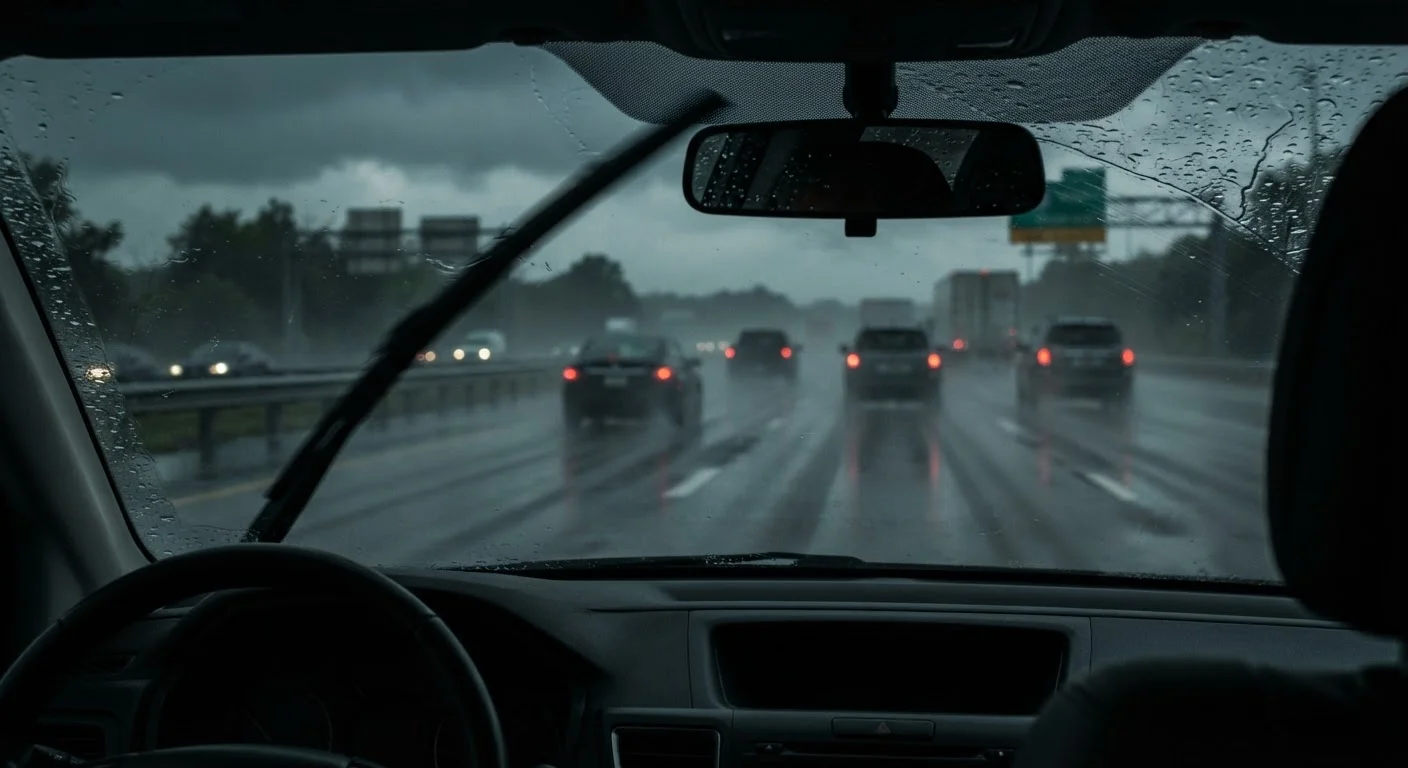
Rain reduces road friction immediately, and the first few minutes of light rain are often the most hazardous. Oil and dust that accumulate on dry pavement mix with water to form a slick surface before rainfall becomes heavy enough to wash it away. Hydroplaning — where your tires ride on a film of water rather than contacting the pavement — becomes a risk at highway speeds, particularly with worn tread.
Spray from large trucks can momentarily blank your windshield entirely, creating a split-second of zero visibility. Increase your following distance behind trucks, slow your speed when passing them, and ensure your wipers and defroster are in working order before any trip in wet weather. For a structured pre-drive checklist, see our pre-trip vehicle inspection guide.
Snow and Ice: When Confidence Becomes a Hazard
Snow and ice demand the largest behavioral shift of any weather condition. Braking, steering, and acceleration all carry far less authority than drivers expect. One of the most well-documented risks in winter driving is overconfidence among drivers with all-wheel drive (AWD) or four-wheel drive (4WD) systems. These systems improve traction during acceleration but offer no meaningful advantage when braking on ice — physics applies equally to every vehicle.
The road safety myths article covers this 4WD misconception in detail, including how it contributes to real crash patterns. In snow, the core adjustments are simple but require discipline: accelerate and brake gradually, extend following distance to at least double the dry-road standard, and reduce speed well below the posted limit.
~17%
Of all vehicle crashes tied to weather
The Federal Highway Administration estimates that roughly 17 percent of all vehicle crashes in the U.S. occur in adverse weather conditions each year.
5–10x
Increase in stopping distance on ice vs. dry road
Road safety research consistently shows that stopping distances on packed ice can be five to ten times longer than on dry asphalt at equivalent speeds.
46%
Weather-related crashes on wet pavement
The Federal Highway Administration reports that wet pavement accounts for approximately 46 percent of all weather-related crash incidents in the United States.
Fog: Visibility Without Depth
Fog is uniquely deceptive because it compresses your sense of depth and makes it difficult to judge how far away other vehicles and obstacles are. Drivers frequently maintain inappropriate speeds because the road ahead appears clear — until it isn't. Dense fog can reduce visibility to under 100 feet, which at 45 mph gives you approximately 1.5 seconds to react to a hazard you first see at that distance.
Use low-beam headlights in fog, not high beams. High beams reflect off fog particles and scatter light back toward you, reducing visibility further. If your vehicle has dedicated rear fog lights, use them to improve your visibility to following traffic. Pull well off the road and turn off your running lights if you need to stop — a vehicle stopped on a shoulder with lights on can be mistaken for a moving vehicle by disoriented drivers.
Fog Lights vs. Low Beams: Know the Difference
Dedicated fog lights are mounted lower on the vehicle and angled to illuminate the road surface rather than straight ahead, reducing the reflected glare that standard headlights create in fog. Not all vehicles have them. If yours does, use front fog lights in addition to low beams in dense fog — but turn them off in clear conditions, as they can temporarily blind oncoming drivers.
Habits That Apply Across All Conditions
While each weather type requires specific adjustments, several principles apply universally in adverse conditions. Slowing down is the most consistently effective action — it extends your reaction time, reduces crash severity, and shrinks stopping distances. Eliminating distractions matters even more when conditions are demanding. And communicating your presence and intentions clearly — using headlights, turn signals well in advance, and smooth braking — reduces the chance that other drivers are caught off guard by your actions.
Driver fatigue compounds adverse-weather risk. Reduced visibility and higher cognitive load accelerate mental fatigue, which in turn degrades hazard perception. For long drives in poor conditions, the risks of underestimating driver fatigue are worth understanding before you set out.
“The most dangerous thing about driving in bad weather isn't the weather itself — it's the gap between how much control drivers think they have and how much they actually have.”
— A transportation safety researcher, Highway safety and driver behavior researcher