What the One-Bag Philosophy Actually Means
One-bag travel sounds simple on paper: bring one bag, skip the rest. In practice, it's a deliberate framework for deciding what actually earns space in your luggage. The philosophy pushes back on the default assumption that more options equal better preparation.
The concept sits in contrast to how many Americans instinctively pack — one outfit per day, multiple pairs of shoes, a just-in-case mentality that turns a weekend trip into a two-checked-bag operation. Several common packing assumptions contribute to this pattern, and most of them don't hold up to scrutiny.
One-bag travel doesn't require asceticism. You're not camping. You're choosing to move through a trip — whether it's three days or three weeks — without the friction that checked bags, heavy rolling suitcases, and packed-to-the-seams duffels create. The constraint forces prioritization that most travelers find liberating once they've actually done it.
Airline Carry-On Rules Vary
Even if your bag fits a standard carry-on size, policies differ by airline, route, and fare class — and can change. Always verify current carry-on dimensions and weight limits directly with your carrier before travel. Budget airlines in particular often have stricter or more variable rules than major carriers.
The Core Principles Behind Packing Less
Three ideas sit at the center of the one-bag approach: versatility over volume, re-wearability over variety, and function over redundancy.
Versatility means every item you pack should work in more than one context. A neutral-colored merino wool sweater pairs with jeans for casual days and dresses up for dinner. A pair of dark pants that reads as semi-formal and casual eliminates the need for two separate choices.
Re-wearability accepts that wearing the same jeans or shirt more than once is not just acceptable — it's the entire strategy. Most travelers on trips longer than four days will need to do laundry regardless of how much they pack. Building around this reality rather than fighting it is what makes week-long one-bag trips work. For a practical framework on this, see packing a week into a carry-on.
Function over redundancy means auditing duplicates. Two pairs of sandals, three chargers, four lip balms — these are the items that quietly fill bags without adding real value. A pre-trip packing audit before you zip up catches most of them.
Start With Your Shoes
Footwear takes up more space than almost any other item in a travel bag. Limiting yourself to two pairs of shoes — one for walking, one for everything else — immediately frees up room for clothing and eliminates one of the most common sources of overpacking. Choose shoes that cross contexts rather than optimizing each pair for a single use.
When One-Bag Travel Makes Sense — and When It Doesn't
The one-bag approach fits naturally for city trips, business travel to familiar destinations, international backpacking, and short-to-medium-length leisure travel. It works when your itinerary is predictable enough to pack for what you'll actually do.
It becomes harder for trips involving extreme temperature swings across a single journey, sports equipment or specialized gear, or extended stays in locations without access to laundry. A ski trip, a camping expedition, or a month-long trip that crosses from tropical to cold climates may genuinely warrant a checked bag — and that's a reasonable decision. The goal is appropriate packing, not packing minimalism as an end in itself.
Weighing carry-on against checked luggage involves real trade-offs around trip type, duration, and the physical demands of the journey. One-bag travel is one point on that spectrum, not the only valid position.
~30L
Typical one-bag travel pack volume
Most one-bag travelers target 20–40 liters, a range that covers the majority of international carry-on restrictions while still holding a week's worth of clothes.
3–5
Tops most one-bag travelers pack per trip
Travel communities and minimalist packing guides commonly reference 3–5 versatile tops as the functional core of a re-wearable capsule wardrobe.
Getting Started: What Honest Editing Looks Like
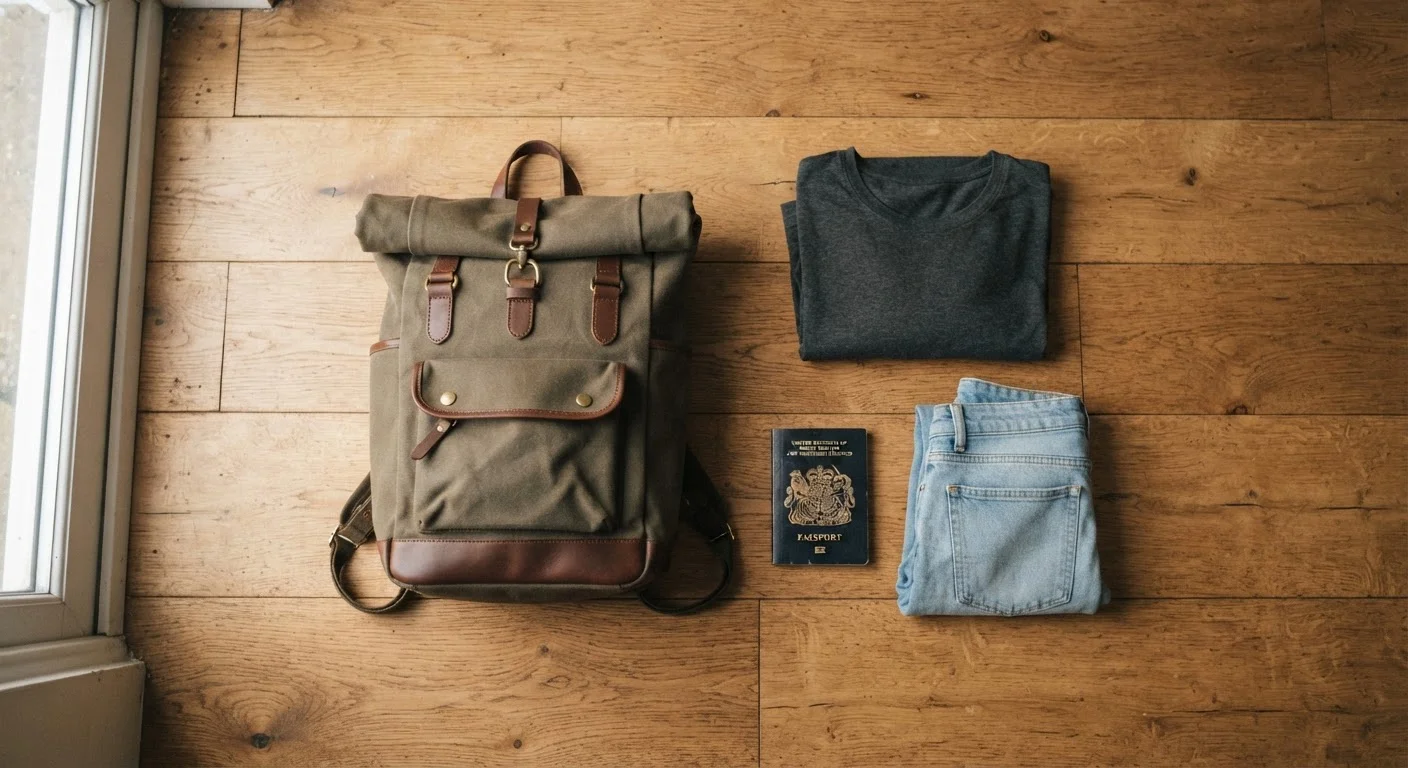
The most effective entry point into one-bag travel isn't buying a new bag — it's emptying your current packing list and rebuilding it item by item. Lay out everything you'd normally pack. Then ask, for each item: Will I use this on at least half the days of this trip? Does something else I'm already bringing do the same job?
What typically survives this process: three to five tops, two bottoms, one layer, minimal footwear (one versatile pair plus sandals or a backup for specific conditions), and a compressed toiletry kit. Electronics get audited too — most travelers carry redundant cables and adapters they never touch.
How you arrange what remains matters too. Rolling, folding, and bundle wrapping each have real trade-offs depending on clothing type, and using the right method for your specific items can meaningfully affect how much fits.
One-bag travel is less a rigid system and more a habit of honest pre-trip editing. The first trip will likely feel underpacked. By the third, most travelers find it hard to go back.