
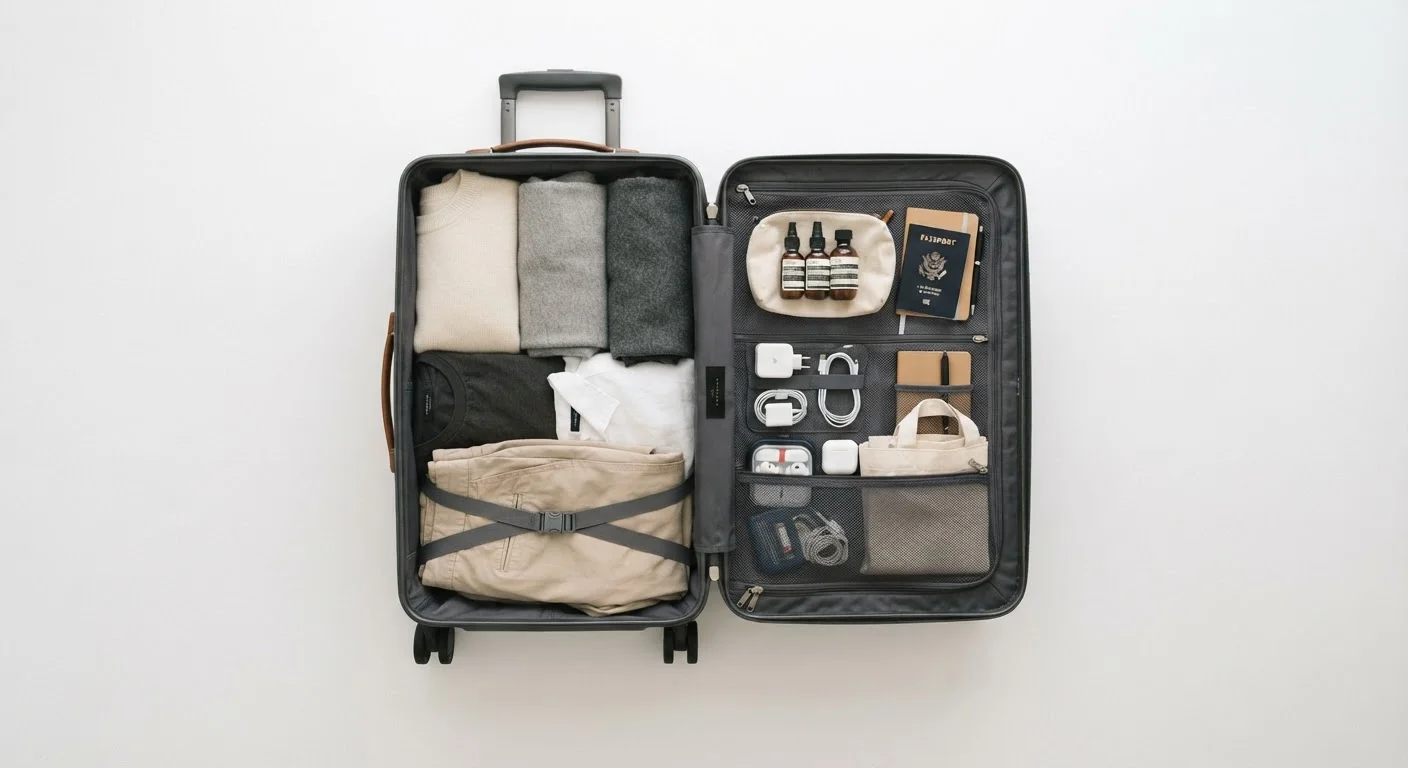
Why Packing Myths Persist
Bad packing advice spreads because it feels logical. Of course you should have outfit options. Of course organization tools save space. Of course preparation means bringing more. The problem is that these assumptions are rarely tested against actual travel experience — they're inherited, repeated, and reinforced by people who also haven't tested them.
The result is bags that routinely exceed what travelers need, adding physical strain and logistical friction to every trip. Understanding which packing "rules" hold up — and which don't — is the first step toward actually packing less. If you're exploring stress-free trip planning strategies, packing decisions are one of the highest-leverage areas to get right before you leave home.
Myth
Packing cubes save space in your luggage.
Fact
Packing cubes organize your bag; they do not compress or reduce total clothing volume.
Packing cubes are genuinely useful for keeping your bag tidy and speeding up unpacking at your destination. But they're organizers, not compressors. Placing clothes inside cubes and then into your bag takes up the same or occasionally more volume than placing clothes directly in. The space-saving perception comes from the visual neatness, not a physical reduction in volume. Compression cubes — a separate product with one-way valves — do slightly reduce volume by forcing air out, though the gains are modest and depend on fabric type.
Myth
You need one full outfit per day to be prepared.
Fact
Most travelers wear the same 4–5 versatile pieces repeatedly, mixing and layering throughout a trip.
The one-outfit-per-day rule assumes you'll sweat through every item, that laundry is unavailable, and that anyone around you will notice or care what you're wearing. In practice, none of those hold. Tops, pants, and layers worn for a few hours in moderate conditions can be re-worn. Most destinations have laundry options — hotel laundry, laundromats, or sink-washing works for lightweight fabrics. Travelers who pack for a week in a carry-on regularly report using fewer than seven distinct outfits. See a realistic week-in-a-carry-on approach for how this plays out in practice.
Myth
Rolling clothes always saves more space than folding.
Fact
Rolling reduces wrinkles for certain fabrics but offers no consistent space advantage over efficient folding.
Rolling works well for soft, lightweight fabrics — t-shirts, casual pants, underwear — because it allows you to fill irregular corners and gaps in a bag. For structured garments like dress shirts, blazers, or stiff denim, rolling often creates creases or uses more space. Folding flat works better for stiffer items. The real answer depends on what you're packing — no single method wins for every clothing type.
Myth
Checking a bag is always more expensive and inconvenient than carrying on.
Fact
Checked bag fees, airline policies, and trip length all affect whether carry-on or checked is the smarter call.
Checked bag fees vary widely by airline, route, and traveler status. Some airline credit cards cover checked bag fees. For longer trips, or when traveling with gear that can't fit overhead, checking a bag is often more practical — and the time cost at baggage claim is frequently overstated. Whether carry-on or checked fits your trip depends on factors specific to your itinerary, not a blanket rule.
Myth
Bringing "just in case" items is responsible travel preparation.
Fact
Most "just in case" items go unused, and the weight penalty is paid on every step of every transit.
"Just in case" packing feels responsible but almost always reflects anxiety rather than probability. The backup shoes for a formal event that doesn't materialize, the three extra chargers, the full first-aid kit for a city trip — these items get hauled through every airport, up every staircase, and into every overhead bin without being touched. A useful test: think back to your last three trips and tally how many "just in case" items you actually used. The patterns behind chronic overpacking are well-documented and largely habitual.
What Lighter Packing Actually Requires
Packing light isn't about deprivation — it's about making deliberate choices before the trip rather than reactive ones at the destination. That means selecting fabrics that dry quickly and resist wrinkles, building a small set of mix-and-match pieces, and resisting the urge to treat your bag as a safety net for every possible scenario.
More Clothes Don't Mean More Options
Bringing extra outfits to cover every scenario rarely plays out — most travelers reach for the same 4–5 pieces repeatedly. The mental overhead of managing a heavy bag often outweighs any flexibility gained. Packing less forces better decision-making before you leave, not after.
Travelers who consistently pack light tend to share one habit: they lay everything out before packing, then remove roughly a third of it. The one-bag philosophy takes this further, but even partial adoption produces meaningful results. Whether that means moving to carry-on only or simply downsizing your checked bag, the principles apply at any scale. For those weighing the full carry-on-only commitment, flying carry-on only comes with real trade-offs worth understanding before you decide.
~50%
Packed clothing typically left unworn
Travel behavior surveys consistently find travelers use roughly half the clothing they pack on a typical trip of five or more days.
~40 lbs
Average checked bag weight reported by frequent flyers
Industry baggage data suggests average checked bags weigh significantly more than necessary, often due to habitual overpacking rather than trip-specific requirements.