The Real Financial Picture
The most cited reason to skip checked bags is cost, and on that front the math is straightforward. Most major U.S. carriers charge $35–$40 for a first checked bag each way, meaning a round trip costs $70–$80 before you've bought a snack. On a two-person trip, that's $140–$160 in fees alone. Multiply over several trips a year and the savings are material.
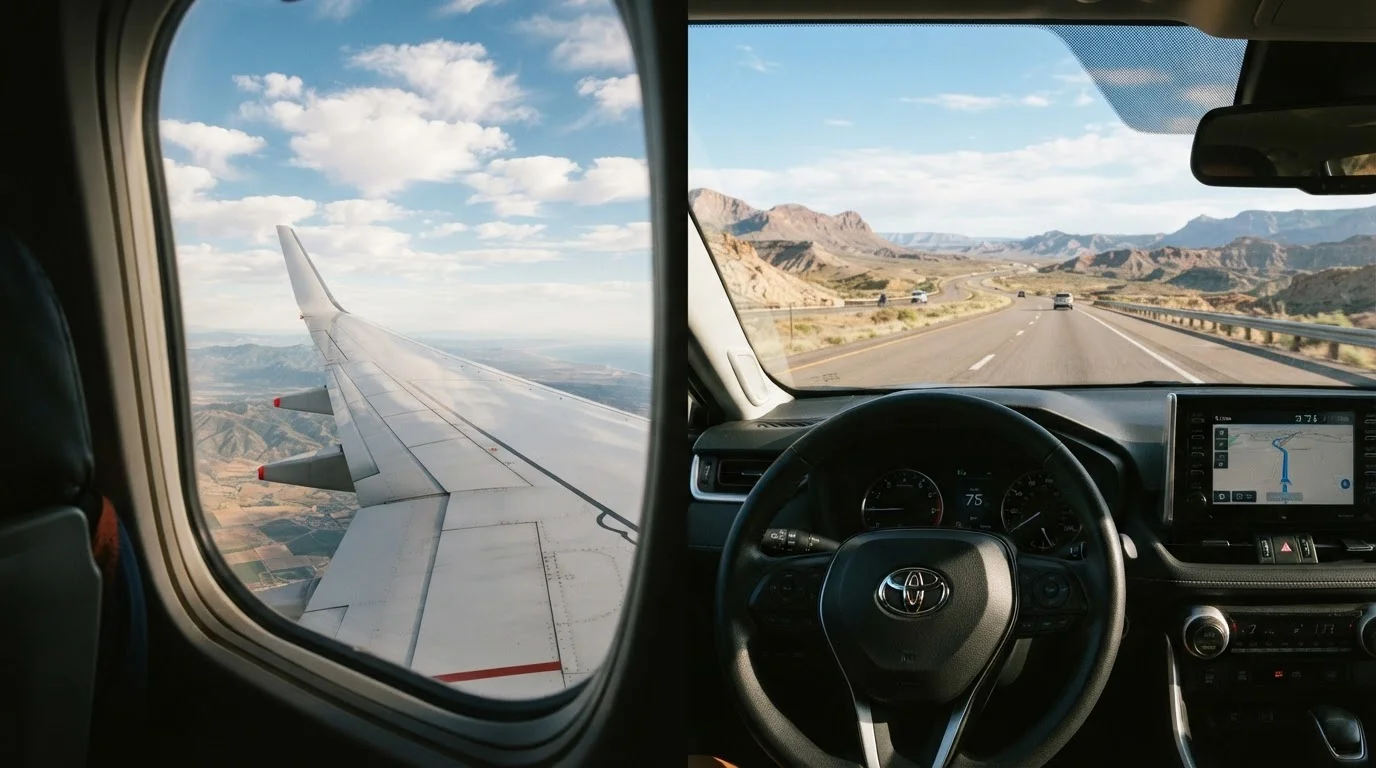
What complicates this is that some airlines — particularly basic economy fares on certain carriers — now restrict carry-on bags to personal items only, effectively flipping the fee structure. Always verify the specific fare class rules before assuming a carry-on is included. The real-cost comparison between flying and driving is a useful broader framework for thinking about total trip costs beyond the ticket price.
$70–$80
Typical round-trip checked bag fee savings
Based on standard first-bag fees of $35–$40 each way charged by major U.S. domestic carriers.
~6 per 1,000
Domestic bags mishandled per flight
Bureau of Transportation Statistics data on U.S. domestic airline baggage mishandling rates in recent reporting years.
What Genuinely Gets Easier
Beyond bag fees, carry-on travel changes the airport experience in measurable ways. You skip the check-in desk entirely if you have a digital boarding pass, clear security in your own time, and walk directly off the plane to ground transportation. On a short domestic trip, this can easily save 45–75 minutes across both ends of a journey.
Lost or delayed luggage is also eliminated as a risk. Airlines mishandled approximately 6 out of every 1,000 checked bags on domestic U.S. flights in recent years, according to data from the Bureau of Transportation Statistics. That rate may sound small, but it's a significant disruption when it's your bag — especially on a short trip where you have no buffer days.
Eliminates checked bag fees on most fares
Domestic bag fees typically run $35–$40 each way per bag. Avoiding them on a round trip saves $70–$80, more on multi-stop itineraries.
Faster airport experience at both ends
No check-in queue, no baggage claim wait. On a typical domestic trip, this can recover 45–75 minutes of travel time.
No risk of lost or delayed luggage
Your bag stays with you through every connection, eliminating the disruption of mishandled bags — a documented issue on roughly 6 per 1,000 domestic flights.
Greater flexibility for rebooking and changes
If your flight is disrupted, a carry-on moves freely to another carrier without re-check fees or coordination with airline staff.
Encourages smarter, lighter packing habits
The constraint of limited space tends to produce more versatile, intentional packing choices that serve most trips better than overpacking.
Flexibility improves too. If your return flight is cancelled and you need to rebook on a different carrier, a carry-on moves with you without re-checking fees or coordination. For travelers on tighter, more efficient packing approaches, this mobility is often the bigger draw than the fee savings.
The Limitations That Don't Get Talked About Enough
Carry-on travel comes with a set of fixed constraints that planning can't fully eliminate. TSA's 3-1-1 liquid rule (containers of 3.4 oz or less, in one quart-sized bag) applies to every passenger every time. If your skincare routine, medications, or toiletries don't fit that framework, you're either buying at the destination or checking a bag.
TSA liquid rules are fixed and non-negotiable
The 3-1-1 rule applies to every carry-on passenger. Full-size toiletries, certain medications, and some skincare products may require checking a bag or purchasing at the destination.
Overhead bin space isn't guaranteed
On full flights, airlines routinely request gate-checks for carry-ons from passengers in rear boarding groups, sending bags to the hold regardless of your planning.
Harder to pack for weather extremes or formal events
Winter layers, suits, formal dresses, and sport-specific gear are difficult to compress into standard carry-on dimensions without leaving essentials behind.
Some fare classes and routes restrict carry-ons
Basic economy fares on several major U.S. carriers limit passengers to a personal item only, making a full carry-on bag a paid upgrade or ineligible entirely.
Requires genuine packing discipline
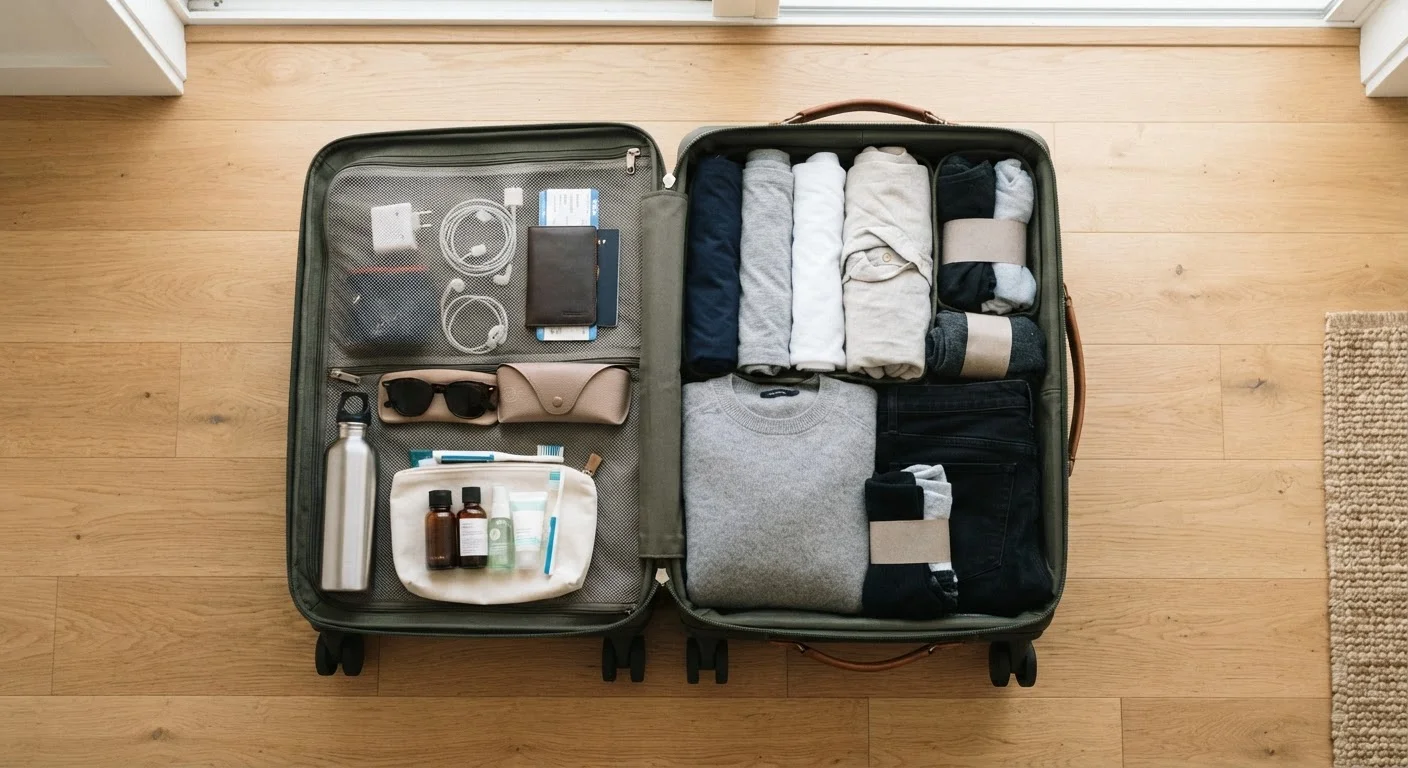
Most travelers underestimate how much editing is needed to fit a week's clothing into 22 inches. Without a tested system, carry-on-only travel often results in forgotten essentials or an overstuffed bag that won't close.
Overhead bin space is not guaranteed on full flights. Airlines routinely ask passengers near the back of the plane to gate-check carry-ons at no charge, but it does mean your bag goes in the hold anyway — negating the speed advantage on that particular flight. Some regional aircraft have bins too small for standard carry-on dimensions regardless of how full the flight is.
Packing discipline is also genuinely harder than most guides suggest. Read the common packing myths that lead travelers to overpack before assuming a week's wardrobe fits comfortably in 22 inches. It often can — but it requires real editing, not just compression.
When It Makes Sense — and When It Doesn't
Carry-on only travel has a strong track record for trips of seven to fourteen days with moderate climates, casual itineraries, and flexible packing lists. It's less reliable for winter travel (bulky layers eat space fast), trips with formal dress requirements, or travel with young children whose gear volume is non-negotiable.
Regional Aircraft Size Limits
Smaller regional jets — commonly used on short-hop domestic routes — often have overhead bins that cannot accommodate standard 22-inch carry-ons. In these cases, the airline typically gate-checks the bag at no charge, but it will travel in the hold. If you're connecting through a small regional leg, verify the aircraft type in advance and factor this into your expectations.
If you're considering the approach for the first time, start with a shorter trip — three to five days — where the stakes of under-packing are lower. The week-in-a-carry-on packing guide and the pre-trip packing audit checklist are practical starting points for building that discipline. For a deeper look at whether the minimalist philosophy fits your travel style, the one-bag travel overview covers the trade-offs honestly.
The decision ultimately comes down to your specific trip, not a universal principle. Comparing carry-on versus checked bag strategies by trip type is the most reliable way to land on the right call rather than defaulting to either extreme.