
Defining the Terms: What Makes a Food 'Whole' or 'Ultra-Processed'?
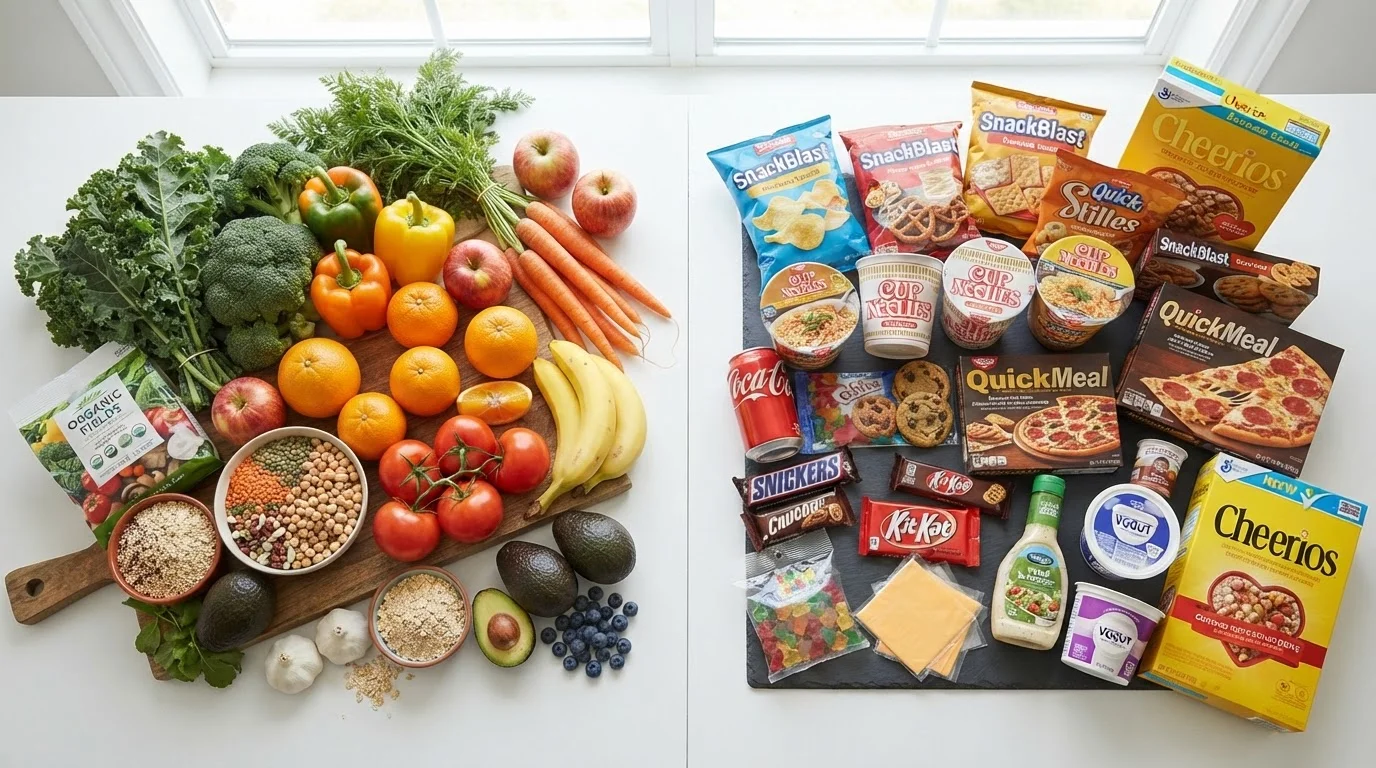
The phrase whole food refers to items consumed in their natural or near-natural state — think fresh produce, legumes, whole grains, eggs, and plain meat or fish. Minimal processing, such as washing, cutting, or cooking, does not disqualify a food from this category. The defining characteristic is that the food's original nutritional matrix — its fiber, vitamins, minerals, and phytonutrients — remains largely intact.
Ultra-processed foods, by contrast, are defined not merely by convenience but by industrial formulation. The most widely used classification framework is the NOVA system, developed by researchers at the University of São Paulo. NOVA groups foods into four categories based on the extent and purpose of processing, placing ultra-processed foods in Group 4. These products are characterized by the presence of additives rarely used in home cooking: emulsifiers, artificial flavors, colorants, humectants, and stabilizers that extend shelf life and enhance palatability.
Examples include mass-produced packaged snacks, reconstituted meat products, flavored instant noodles, sweetened breakfast cereals, and many carbonated soft drinks. Critically, the issue with ultra-processed foods is not processing itself — it is the nature and degree of industrial manipulation that separates them from even canned or frozen vegetables, which remain minimally processed.
NOVA Is a Research Tool, Not a Regulatory Standard
The NOVA classification system is widely used in nutritional epidemiology research and public health discussions, but it is not an official regulatory category used by the U.S. FDA or USDA. Food labels in the United States do not use NOVA designations. NOVA is best understood as a framework for thinking about processing levels rather than a definitive legal or clinical classification.
Side-by-Side: How They Compare Nutritionally
The nutritional differences between whole and ultra-processed foods extend well beyond simple calorie counts. Understanding what each category contributes — or strips away — helps contextualize why processing level matters for overall dietary quality.
| Criterion | Whole Foods | Ultra-Processed Foods |
|---|---|---|
| Fiber content | Naturally intact; often high | Frequently degraded or absent |
| Micronutrient density | High; vitamins and minerals retained | Low; often fortified artificially |
| Added sugars | Absent or trace amounts | Commonly high |
| Sodium levels | Naturally low | Often elevated for preservation/flavor |
| Additives and emulsifiers | None or minimal | Numerous; industrial formulation |
| Phytonutrients | Present; bioactive compounds intact | Largely absent |
| Satiety per calorie | Generally higher due to fiber and protein | Generally lower; energy-dense |
Whole foods tend to deliver nutrients in a form the body recognizes and absorbs efficiently. Dietary fiber, for instance, is often degraded or absent in ultra-processed products, contributing to what researchers describe as a widespread "fiber gap" in American diets. For a deeper look at this issue, see why most Americans fall short on fiber.
Ultra-processed foods also tend to be energy-dense but nutrient-sparse, often delivering high amounts of added sugars, refined starches, and sodium alongside minimal micronutrient content. Understanding how macronutrients function in the body can help clarify why the quality — not just quantity — of carbohydrates, proteins, and fats matters.
What the Research Associates with Ultra-Processing
A growing body of large-scale observational research links higher ultra-processed food consumption to elevated risk of several chronic health conditions. Studies published in journals such as The BMJ and JAMA Internal Medicine have associated high ultra-processed food intake with increased incidence of cardiovascular disease, type 2 diabetes, obesity, and colorectal cancer. A 2024 umbrella review of the evidence, examining over 45 meta-analyses, found consistent associations between ultra-processed food consumption and adverse health outcomes across multiple disease categories.
It is important to note that most of this evidence is observational, meaning it identifies associations rather than proven causation. Researchers continue to investigate whether the additives themselves, the degraded nutritional profile, the displacement of healthier foods, or a combination of all three drives these associations. That uncertainty does not diminish the practical dietary guidance — it simply underscores the importance of nuanced interpretation.
57%
Share of U.S. calories from ultra-processed foods
Research published in BMJ Open estimated that ultra-processed foods account for approximately 57% of energy intake among U.S. adults.
32%
Higher cardiovascular disease risk association
A large prospective study published in The BMJ found a roughly 32% higher risk of cardiovascular disease among the highest ultra-processed food consumers versus the lowest.
10%
Spontaneous calorie increase in ultra-processed diet
A controlled NIH clinical trial found participants consumed approximately 500 more calories per day when offered an ultra-processed diet versus an unprocessed diet, without being instructed to do so.
For readers interested in how food quality interacts with broader eating patterns, comparing established dietary patterns side by side provides useful context on how different frameworks approach food processing.
Making the Distinction Practical in Everyday Eating
The goal is not to categorize every food with rigid precision or to pursue an idealized diet. A useful starting point is learning to read food labels critically — reading a Nutrition Facts label without getting lost is a practical skill that helps identify added sugars, sodium levels, and ingredient complexity at a glance.
Practically, shifting dietary quality often means substitution rather than elimination. Replacing a packaged snack with a handful of nuts, choosing plain canned beans over a heavily seasoned processed product, or opting for rolled oats instead of a sweetened instant variety are changes grounded in evidence and achievable without major lifestyle disruption. These incremental adjustments collectively move a diet toward greater whole-food density over time.
Not all processing is equal or harmful. Pasteurized milk, canned tomatoes, and plain frozen spinach are processed foods that retain strong nutritional profiles. The NOVA framework's value lies in helping consumers distinguish between these minimally processed staples and products engineered primarily for maximum palatability and market shelf life.
This article is for general informational and educational purposes only and does not constitute medical or dietary advice. For personalized nutrition guidance, consult a registered dietitian or qualified healthcare professional.