
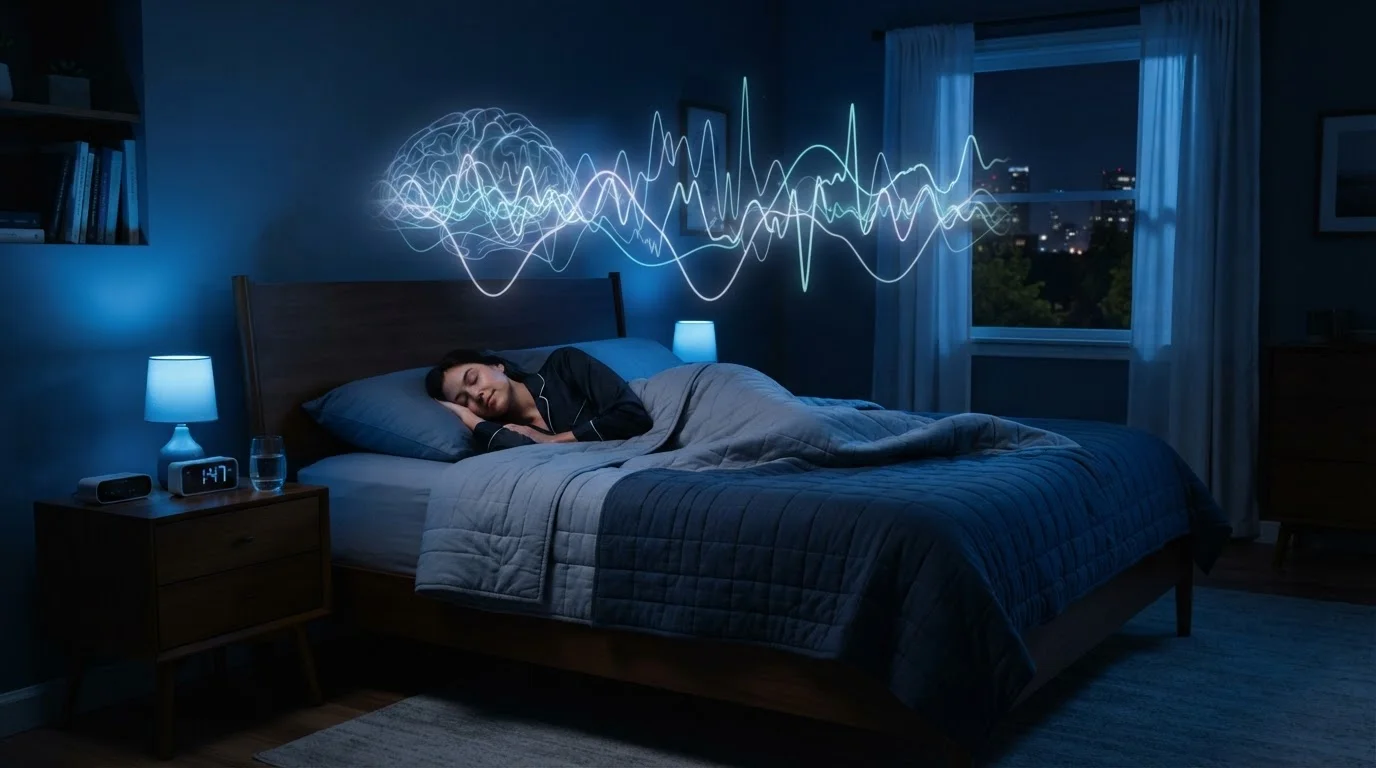
The Four Stages of Sleep
Sleep researchers classify sleep into four stages based on distinct brain wave patterns recorded by electroencephalography (EEG). The first three — Stages 1, 2, and 3 — are categorized as non-REM (NREM) sleep. The fourth is REM sleep, named for the rapid movement of the eyes beneath closed lids.
Stage 1 (NREM) is the lightest phase, lasting just one to seven minutes at the start of the night. Brain activity slows, muscles relax, and you drift in and out of consciousness. This is when some people experience hypnic jerks — sudden muscle twitches that can jolt you awake.
Stage 2 (NREM) accounts for roughly half of total sleep time in most adults. Your heart rate drops, body temperature falls, and the brain produces sleep spindles — bursts of rhythmic neural activity thought to play a role in sensory processing and memory filtering.
For a deeper look at the terminology used throughout sleep science, see The Vocabulary of Sleep.
~50%
Of sleep time spent in Stage 2 NREM
According to sleep architecture data published in peer-reviewed sleep research, Stage 2 accounts for approximately half of total nightly sleep in healthy adults.
20–25%
Of total sleep time in REM for adults
The American Academy of Sleep Medicine notes that healthy adults spend roughly one-fifth to one-quarter of their night in REM sleep.
90 min
Average length of one complete sleep cycle
Sleep researchers consistently report that a full NREM-to-REM cycle spans approximately 90 minutes, though individual cycles vary.
Deep Sleep: When Your Body Does Its Best Repair Work
Stage 3 (NREM), often called slow-wave sleep or deep sleep, is characterized by large, slow delta brain waves. It is the hardest stage to wake from and the most physically restorative part of the sleep cycle.
During deep sleep, the pituitary gland releases growth hormone, which supports tissue repair and muscle development. The immune system becomes more active, and the brain clears metabolic waste products through the glymphatic system — a drainage network that research suggests is most active during this phase. Blood pressure drops, breathing stabilizes, and the body enters a state of genuine physiological rest.
Deep sleep is front-loaded: most of it occurs in the first two to three cycles of the night, which is one reason that cutting sleep short — even by one or two hours — disproportionately reduces this critical stage.
Protect Your Early Night Sleep
Because deep sleep is concentrated in the first half of the night, going to bed at a consistent time is one of the most reliable ways to preserve it. Delaying bedtime — even occasionally — reduces the total deep sleep you accumulate, since the brain cannot simply shift the timing of Stage 3 to later in the night.
REM Sleep: Memory, Emotion, and the Dreaming Brain
REM sleep typically begins about 90 minutes after you fall asleep and grows longer with each successive cycle. By the final cycles of an eight-hour night, a single REM period can last up to an hour.
During REM, brain activity closely resembles the waking state — yet the body's voluntary muscles are temporarily paralyzed, preventing physical acting-out of dreams. This stage is associated with the consolidation of procedural and emotional memories, emotional regulation, and the kind of creative, associative thinking that underlies problem-solving. Research published in peer-reviewed journals has consistently linked REM sleep to learning efficiency and psychological resilience.
“Sleep is not simply a passive state of unconsciousness. It is an active, highly organized process during which the brain performs essential maintenance that cannot occur while we are awake.”
— Matthew Walker, Professor of Neuroscience and Psychology, University of California, Berkeley; author on sleep science
Because REM sleep is concentrated in the later part of the night, consistently sleeping fewer than seven hours means you are sacrificing a disproportionate share of it. This is a nuance worth understanding — and one that challenges common sleep misconceptions. See Sleep Myths That Are Keeping You Up at Night for more on what the science actually shows.
Why Cycle Completion Matters More Than Hours Alone
The architecture of your sleep — how your cycles are structured and completed — matters just as much as total duration. A night of six hours spent in continuous, undisturbed cycles may deliver more restorative sleep than eight fragmented hours broken by repeated awakenings.
Consistency in your sleep schedule also reinforces cycle architecture. When you go to bed and wake at roughly the same time each day, your circadian rhythm — the body's internal 24-hour clock — aligns more predictably with your sleep stages. Why Consistency Beats Duration in Sleep Health explores this dynamic in greater depth.
If you find your sleep quality consistently poor, building a deliberate pre-sleep routine can help signal to your brain that it's time to wind down. Your Pre-Sleep Routine outlines evidence-backed behavioral strategies for doing exactly that. And if a poor night does happen, Recovery Habits After Poor Sleep covers what you can do the next day to support focus and resilience.
This article is for general informational purposes only and does not constitute medical advice. If you have concerns about your sleep quality or a possible sleep disorder, consult a qualified healthcare professional.