Why Financing Myths Cost Drivers Real Money
Auto financing is one of the least transparent parts of buying a car. The numbers are real, but how they're presented — monthly payments front and center, total loan costs buried in fine print — makes it easy to misread what you're actually agreeing to. These misconceptions don't just affect the purchase moment; they shape what you pay for years. Understanding the difference between how a loan looks and what it actually costs is one of the most practical things a car buyer can do.
Beyond the loan itself, financing decisions interact with ownership costs like insurance, depreciation, and maintenance. For a fuller picture of what car ownership involves financially, see our guide on the real price of owning a car beyond the sticker.
Myth
If I can afford the monthly payment, I can afford the car.
Fact
Monthly affordability is only one dimension of cost — the total interest paid over the loan term is equally, if not more, important.
A $400 monthly payment sounds manageable, but if that payment spans 84 months at a high interest rate, the total interest paid could exceed $6,000–$8,000 on a mid-priced vehicle. The monthly figure tells you about short-term cash flow, not the true price you're paying for the car. Use an amortization calculator to see the full interest cost before committing.
Myth
Longer loan terms are always a smarter financial move.
Fact
Extending a loan term lowers the monthly payment but increases total interest paid and raises the risk of becoming "upside down" on the loan.
Being "upside down" — or having negative equity — means you owe more on the loan than the car is currently worth. New vehicles depreciate quickly in the first few years, and a 72- or 84-month loan may not pay down principal fast enough to keep pace. If the car is totaled or you need to sell early, you could owe the lender money even after the insurance payout. See how these costs accumulate in our five-year ownership cost breakdown.
Myth
Dealer financing is the easiest and most convenient option, so it's worth it.
Fact
Dealer financing is convenient, but convenience often carries a price premium — independent lenders frequently offer more competitive rates.
Dealerships work with a network of lenders and may mark up the interest rate above what the lender actually requires, keeping the difference as profit. Getting pre-approved through a bank, credit union, or other lender before visiting a dealership gives you a baseline rate to compare against. Our guide on dealer financing vs. your own auto loan walks through how both paths work.
Myth
Your credit score only affects whether you're approved, not how much the loan costs.
Fact
Credit score directly influences the interest rate offered, which can translate to thousands of dollars in difference over a loan's life.
Lenders tier their rates based on creditworthiness. A borrower with a strong credit profile may qualify for a significantly lower annual percentage rate (APR) than someone with a fair score — on the same vehicle, from the same lender. Over a five-year loan, even a two or three percentage point difference in APR can add up to $1,500–$3,000 or more in extra interest. Learn how lenders use this data in our article on how your credit score shapes every loan offer.
Myth
Zero percent financing deals always mean you're getting the car for free of extra charges.
Fact
Zero percent APR offers are typically reserved for buyers with excellent credit, and may come with trade-offs like forgoing a manufacturer rebate.
Automakers sometimes offer buyers a choice: take the low-APR financing or take a cash rebate and arrange your own financing. In many cases, the rebate plus a competitive outside rate results in a lower total cost than the zero percent offer. Do the math on both paths before deciding, since the "free financing" headline doesn't always reflect the full picture.
Reading the Fine Print Before You Sign
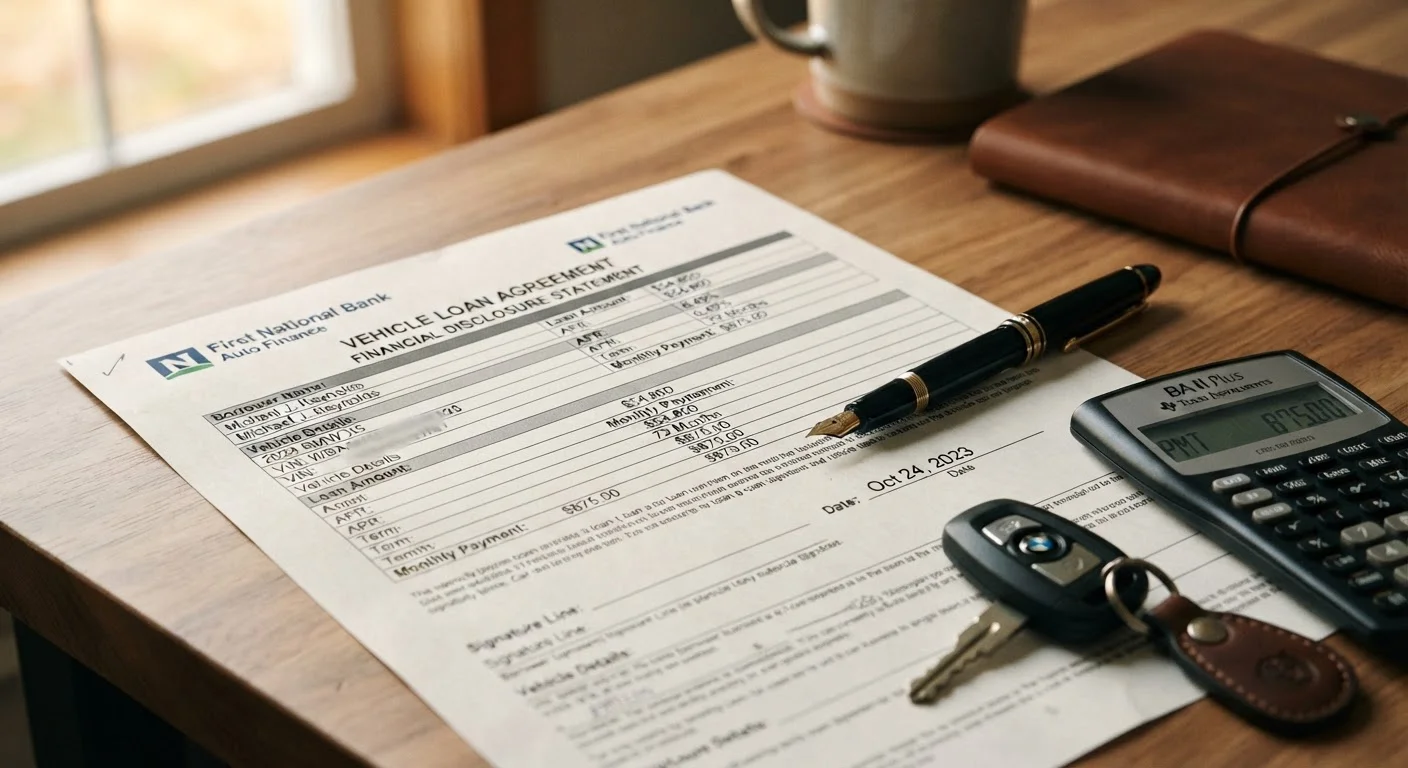
The finance office at a dealership is where many buyers make decisions under time pressure with unfamiliar documents. Add-on products — extended warranties, paint protection, gap insurance — are often bundled into the loan total without clear explanation of their individual costs. Each dollar added to the principal is a dollar you'll pay interest on.
Rolled-In Fees Can Be Hard to Spot
Dealers may offer to roll taxes, registration fees, and add-on products directly into your loan. While this reduces out-of-pocket costs at signing, you then pay interest on those fees for the entire loan term. Ask for an itemized breakdown of everything included in the financed amount before agreeing to any terms.
Gap insurance (which covers the difference between what you owe and what your car is worth if it's totaled) can be a legitimate product for certain buyers, but it's often available from your own auto insurer at a lower cost than what dealers charge. Compare before accepting what's offered at the finance desk.
Monthly Payment ≠ Total Loan Cost
Focusing only on the monthly payment is one of the most costly mistakes car buyers make. A lower payment stretched over 72 or 84 months may mean you pay thousands more in interest than a shorter loan at the same rate. Always calculate the total amount paid over the full loan term — not just what leaves your account each month.
For a broader look at how buying decisions affect long-term costs, including whether new, certified pre-owned, or used makes sense for your situation, our article on understanding the real differences between new, CPO, and used covers the key trade-offs. And for a quick-reference view of what a typical year of ownership actually costs, see our annual car ownership costs breakdown.
This article is for general informational and educational purposes only. It does not constitute financial or legal advice. Readers should consult a qualified financial professional before making financing decisions.